










HR’s Free, Customizable Template
Most engagement programs stall not because HR leaders lack intent, but because they lack a consistent way to gather signal. A structured employee engagement survey template fixes that, giving your team a repeatable process, comparable data over time, and questions that employees take seriously.
Paycor’s free employee engagement survey template is ready to use, fully editable, and built around the categories that predict retention and performance. Download it below or keep reading to see what’s inside.
What Is an Employee Engagement Survey Template?
An employee engagement survey template is a pre-built set of structured questions designed to measure how connected, motivated, and committed employees feel toward their work and your organization. Rather than building a survey from scratch each cycle, a template gives HR teams a consistent framework — standardized categories, tested question phrasing, and a ready-to-deploy format.
Good templates cover the dimensions that research links to retention and performance: manager relationship quality, role clarity, growth opportunity, sense of belonging, and alignment with organizational values. They’re not a one-size-fits-all questionnaire. They’re a jumping off point that HR teams can adapt to their workforce and cadence.
Why You Need to Use an Employee Engagement Survey Template
Building an employee survey from scratch introduces a problem most HR teams don’t realize until they’re two cycles in: your data isn’t comparable. If question phrasing shifts between surveys, you can’t track trends. You’re measuring something different every time.
A template solves that dilemma. It creates the consistency required to answer the questions that truly matter to leadership: Is engagement improving? Which teams are struggling? What changed between Q1 and Q4?
There’s also the time factor. Drafting and validating survey questions takes longer than most HR teams budget for, and cutting corners on question design produces data you can’t act on. A well-constructed template lets you spend your time on analysis and follow-through, not question-writing.
One more thing templates do that informal check-ins don’t: they create psychological safety through anonymity. Employees are more likely to give honest responses when they trust the process is structured and confidential. Ad-hoc questions in a team meeting rarely produce the same feedback.
Benefits of Using an Employee Engagement Survey Template
Consistent, Comparable Data Over Time
Running the same core questions across survey cycles is how you build a longitudinal picture of your workforce. Standardized templates make it possible to identify trends — rising disengagement in a specific department, improving scores after a management change, seasonal dips that predict Q1 attrition. Without consistency, you’re collecting anecdotes. With it, you’re building evidence.
Faster Deployment, Better Participation
When the survey structure is already validated, HR teams can move from decision to deployment in days rather than weeks. Faster deployment matters because it shortens the gap between when something happens in the organization and when you get data about it. Employees are more likely to complete a focused, well-structured survey than a long, poorly organized one, and completion rates directly affect whether your data is representative.
Credible Findings That Leadership Will Act On
Survey data gets ignored when executives don’t trust it. A structured template with clear methodology and consistent administration is easier to defend in a leadership meeting than a one-off questionnaire HR cobbled together between two other competing priorities. Templates signal rigor. Rigor produces credibility. Credibility results in action.
Best Employee Engagement Survey Templates to Use
Not every engagement question belongs in the same survey. The right template depends on where the employee is in their lifecycle and what you’re trying to measure.
Employee satisfaction survey template. This is the broadest type of survey. It covers compensation perception, work environment, manager effectiveness, and growth opportunity. It’s best for annual or semi-annual cycles where you want a full-spectrum view.
Onboarding survey template. These questionnaires are designed for new hires at 30, 60, and 90 days. They measure clarity of role expectations, quality of onboarding support, and early signs of belonging or disconnection. Early attrition is expensive; this is where you catch it.
Exit interview survey template. Exit interviews capture reasons for departure with enough structure to aggregate themes across departing employees over time. Exit data only becomes useful when it’s comparable.
Pulse survey template. These surveys are short (1–5 questions), frequent (monthly or quarterly), and highly targeted. They’re ideal for monitoring sentiment in real time or following a significant organizational change such as a restructure, a policy shift, or a leadership transition.
Remote employee survey template. This type of survey addresses dimensions that don’t map cleanly onto in-office assumptions: communication quality, access to tools and support, sense of inclusion in remote-first or hybrid environments, and the blurred line between work and personal time.
Example Questions in the Sample Employee Engagement Survey Template
The full template covers multiple engagement dimensions. Here’s a representative sample across categories:
Role clarity and expectations
- I clearly understand what is expected of me in my role.
- I have the tools and resources I need to do my job well.
Manager relationship
- My manager gives me feedback that helps me improve.
- I feel comfortable raising concerns with my manager.
Growth and development
- I have opportunities to learn and grow in my current role.
- I can see a clear path for advancement at this organization.
Belonging and inclusion
- I feel like I belong at this organization.
- My contributions are recognized and valued.
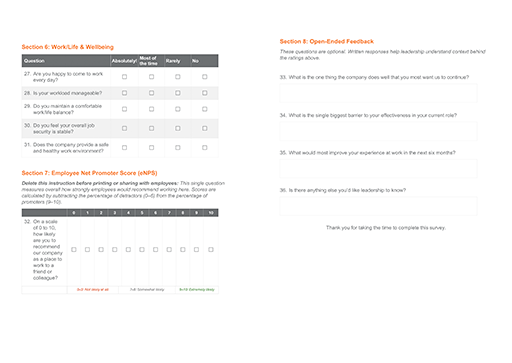
Most questions use a 5-point agreement scale (Strongly Disagree to Strongly Agree). The full template includes additional open-text questions, a net promoter-style eNPS question, and department-level filters. Download it to see the complete set.
How to Use This Example Employee Engagement Survey Template Effectively
Align on Cadence Before You Launch
Decide whether you’re running this as an annual survey, a semi-annual cycle, or a quarterly pulse before you distribute. Cadence affects how you frame the survey to employees, how you plan to use the data, and whether you can realistically act on findings before the next cycle. Launching a survey with no plan for what happens afterward is how you train employees not to take future surveys seriously.
Communicate Before and After
Tell employees why you’re running the survey, what you’ll do with the results, and when they can expect to hear back. Then actually follow through. The single most damaging engagement survey outcome isn’t low scores — it’s silence after employees submitted honest feedback. A response plan is not optional.
Customize for Your Context Without Breaking Comparability
You can and should adapt the template to your organization. Add questions specific to your industry, your current initiatives, or your known pain points. What you should not do is change the core questions every cycle. Keep a stable set of questions consistent across surveys so you can track changes over time. Add supplemental questions in a clearly separate section.
Segment Your Analysis
Company-wide averages hide what matters. A 72% favorable score across the organization can mask a 45% score in a specific department, a significant gap between tenures, or a disconnect between individual contributor and management responses. Before presenting results to leadership, cut the data by department, role level, and tenure at minimum.
Download Your Free Employee Engagement Survey Template
Paycor’s free employee engagement survey template includes 40+ validated questions across five engagement dimensions, an eNPS question, open-text prompts, and a structured format designed for both digital distribution and print. It’s fully editable and built to work regardless of workforce size or industry.
This template is one component of a broader engagement strategy. If you’re looking to automate survey distribution, track results over time, and connect engagement data to your broader HR data — including compensation, performance, and turnover — Paycor’s platform does that. But the template is a useful starting point regardless of the tools you’re using today.
Employee Engagement Survey Template FAQs
Can I customize the employee engagement survey template?
Yes. The template is fully editable. You can add, remove, or reword questions to fit your organization’s context, culture, or current priorities. One recommendation: keep the core question set stable across survey cycles so your data stays comparable over time. Add custom questions in a separate section rather than replacing the standard questions.
Can I use the employee engagement template for all industries?
The core template is industry-agnostic — the dimensions it measures (manager effectiveness, role clarity, growth opportunity, belonging) apply across sectors. Some questions may need light adaptation for industries with specific working conditions, like manufacturing, healthcare, or field-based roles. The template is a starting point, not a locked document.
Does this employee engagement survey template work for all employee roles?
It works for the majority of roles. For employees without regular computer access — hourly workers, frontline staff, field teams — you may want to consider how the survey is distributed (print, SMS, kiosk) rather than changing the questions themselves. The template includes a printable format for exactly that reason.
Is this a printable employee engagement survey template?
Yes. The template is formatted to print cleanly on standard paper. If you’re administering the survey to employees without digital access, or prefer a physical format for certain locations or shift structures, the print version works without any reformatting on your end.