







The Difference a Skills Gap Analysis Template Can Make
Skills gaps are expensive. When employees lack key abilities, your team loses momentum and fails to keep up with the competition. But these gaps are also a sign of growth; your company is expanding, your industry is changing, and your team needs to work hard to keep up.
Most organizations know they have gaps, but don’t take the time to identify which skills matter most. But HR shouldn’t guess about priorities. Instead, leaders should collect data, develop insights, and design strategic plans for upskilling employees.
Our skills gap analysis template empowers you to make a plan. Use this proven framework to assess your team, pinpoint important skills, and create a data-driven training program.
What’s a Skills Gap Analysis Template?
A skills gap analysis template is a structured tool that measures the difference between your team’s current capabilities and the skills your business needs most. Our template gives HR a standardized format to assess each role, define required proficiency levels, evaluate current performance, and identify gaps.
Who is This Skills Gap Analysis Template Made For?
This template works for any organization that needs to align current employee capabilities with long-term business goals. It can help you plan for growth, adapt to industry changes, and address performance issues, all at the same time. Some individuals who should use it include:
- HR Leaders: Use the template to support workforce planning. Decide which skills matter most for upcoming initiatives, prioritize training investments, and build a roadmap for strategic talent management.
- Managers and Team Leaders: Use it during performance reviews and development planning. The structured format helps you set clear expectations, track progress, and create actionable career paths for direct reports.
- Business Leaders: Use skills gap analysis to ensure the organization has the capabilities it needs to compete in the market. The data helps you decide whether to train existing employees, hire new talent, restructure teams, or take a combination approach. Upskilling is especially important in this era; experts predict that nearly half of workers will need retraining by 2030 (SHRM).
- Small businesses and those with limited HR resources benefit from the template’s straightforward approach.
- Larger companies can use it to standardize assessments across departments, facilitating transparency and communication.
What Format Does the Skills Gap Analysis Template Come In?
Our skills gap analysis template is a free, downloadable PDF. HR leaders can use the template as is or customize it to meet the needs of their unique teams or industry.
PDF templates work for most organizations because they’re easy to share, print, and distribute across teams. You can fill them out digitally or print copies for in-person discussions with managers and employees.
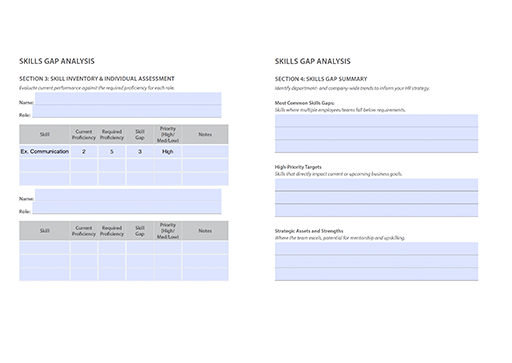
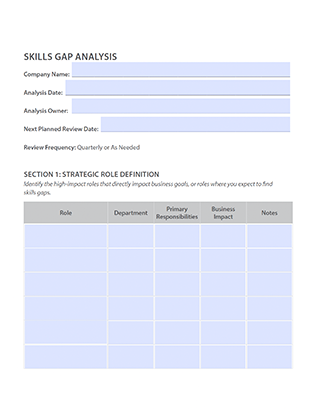
The template includes clear sections for role definitions, skill inventories, proficiency ratings, and skill gaps. Customize the fields to reflect your industry, add relevant skills, and adjust specific criteria to align with your business goals.
How To Use This Employee Skills Gap Analysis Template
Follow these steps to complete your skills gap analysis and build a targeted development strategy.
Step 1: Define Roles
Start by listing the key roles you’re analyzing. Focus on positions that directly impact business goals or where you suspect capability gaps exist. Include job titles, primary responsibilities, and the skills these employees would need to reach performance goals.
Step 2: Set Proficiency Scales & Requirements
Create a clear rating system to measure skill levels. Most organizations use a 1-5 scale where 1 represents basic awareness, and 5 represents expert-level mastery. Define what each rating means so managers can evaluate employees consistently. Then set the required proficiency level for each skill based on role expectations.
Step 3: Enter Skill Ratings
Evaluate current employee performance against your proficiency scale. Collate managers’ comments (including past performance reviews), peer feedback, and self-assessments to get accurate ratings. Document the current proficiency level for each skill in the template.
While hard data is important here, evaluating employees will always be a subjective process. Make sure to leave a notes section for qualitative feedback.
Step 4: Analyze Scoring
Review the ratings to identify patterns. Look for skills where multiple employees fall below requirements, roles where gaps cluster in specific areas, and high-priority skills that directly impact your business results.
Step 5: Determine Gaps
Calculate the difference between required and current proficiency levels. Prioritize gaps based on business impact, urgency, and the feasibility of closing them through recruiting or training programs. Use this analysis to build your HR strategy, then share it with the C-suite to secure executive support.
How to Access the Free Skills Gap Analysis Template
Download the skills gap analysis template directly from this page. You can use it immediately or customize it to meet your organization’s needs. Share the final version with your HR team and managers in every department to ensure company-wide consistency.
Download Your Employee Skills Gap Analysis Template Today
Stop guessing what your team needs to succeed. Paycor’s HR tools empower leaders to identify skill gaps, prioritize training investments, and build a workforce ready to face the future.
Download the template to start making better decisions about your talent strategy.
Skill Gap Analysis Template FAQ
Get answers to HR’s most common questions about using a skills gap analysis template.
What are the benefits of using a template for skill gap analysis?
An employee skills gap analysis template gives you objective data about your team’s capabilities. These insights help HR work more strategically. Use your findings to inform training budgets, hiring decisions, and succession planning. The template gives everyone on your team a shared framework, driving consistency and efficiency across departments.
Can I use the skills gap analysis template for my whole department?
Yes. The template works for individual employees, entire departments, and companies as a whole. Distribute copies to each manager and consolidate the results to identify patterns across your team.
Is this a free skills gap analysis template?
Yes. Download the template at no cost and use it as many times as you need. No subscription or payment required.
Will this employee skill gap analysis template help me create a skills inventory?
Yes. The template includes sections to document your team’s current skills, which is the foundation of a comprehensive skills inventory. When you know exactly which skills exist within your organization, you can redeploy talent strategically and reduce your reliance on external hiring.
Can I edit the example skill gap analysis template to fit my business?
Yes. Customize the template to match your industry, company size, and specific skill requirements. Add or remove skills, adjust proficiency scales, and change evaluation criteria to align with your business goals.