










What is a Cost-Benefits Analysis Template?
A cost-benefit analysis template is a structured worksheet that helps you weigh the projected costs of a decision against its expected benefits. Instead of debating an investment in the abstract, you list every cost, assign a dollar value to every benefit, and let the numbers tell the story.
Finance teams, HR leaders, and business owners use a CBA template to evaluate decisions like purchasing new software, adding headcount, expanding to a new location, or outsourcing a business process. The template keeps the analysis consistent so you can compare options side by side and present a clear recommendation to stakeholders.
What Is Included in the Cost-Benefits Analysis Template?
This free template gives you everything you need to run a complete analysis from start to finish. It includes:
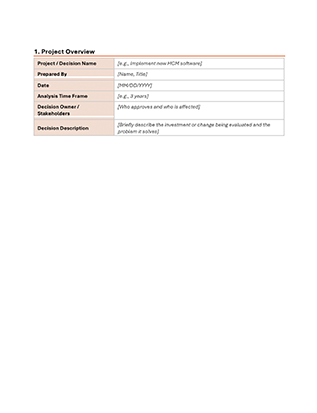
- A project overview section to define the decision, time frame, and stakeholders
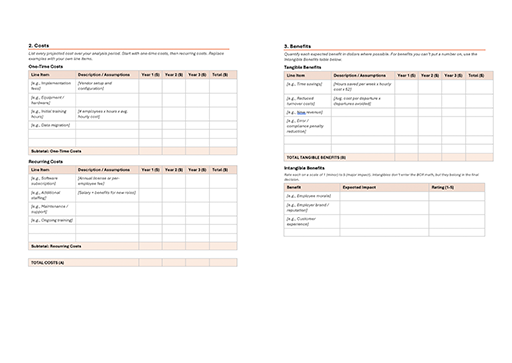
- A costs worksheet covering one-time costs (implementation, equipment, training) and recurring costs (subscriptions, salaries, maintenance)
- A benefits worksheet for tangible benefits (revenue, cost savings, productivity gains) and intangible benefits (morale, retention, brand reputation)
- Built-in totals for net benefit and benefit-cost ratio (BCR)
- A risk and assumptions log to document what could change your numbers
- A decision summary section to record your recommendation and next steps
Every section is fully editable, so you can add line items, adjust time frames, and tailor the worksheet to your business.
Who Should Use the Free Cost-Benefit Analysis Template?
This template was built for decision-makers who need to justify spending with data. It works best for:
- Finance leaders and CFOs evaluating budget requests and capital expenditures
- HR directors building the business case for new HR technology, benefits programs, or additional headcount
- Business owners deciding whether to invest in equipment, expansion, or outsourcing
- Department managers who need leadership approval for a project or purchase
- Project teams comparing multiple vendors or approaches before committing
If a decision involves real money and more than one stakeholder, a documented cost-benefit analysis will move the conversation forward faster than opinion ever will.
Benefits of Using a Cost-Benefits Analysis Template
A template turns a complicated financial exercise into a repeatable process. Here’s what you gain:
- Faster decisions. A standardized format means you spend time analyzing, not building a worksheet from scratch.
- Stronger business cases. Leadership responds to numbers. A completed CBA shows you’ve done the homework.
- Consistent comparisons. When every proposal follows the same structure, you can evaluate competing options fairly.
- Fewer blind spots. Prompts for hidden costs and intangible benefits surface factors that informal analysis misses.
- A paper trail. Documented assumptions make it easy to revisit a decision later and learn from the results.
How to Use the CBA Template
Follow these six steps to complete your analysis:
- Define the decision. Start with the project overview. Name the decision you’re evaluating, the time frame for your analysis (one year, three years, five years), and who owns the outcome.
- List every cost. Work through one-time costs first (setup fees, hardware, training hours), then recurring costs (licenses, salaries, maintenance). When in doubt, include it. Underestimating costs is the most common CBA mistake.
- Quantify the benefits. Assign dollar values to tangible benefits like added revenue, time savings, and reduced turnover costs. For intangible benefits, describe the impact and rate it on the provided scale.
- Calculate the totals. Subtract total costs from total benefits to get your net benefit. Divide total benefits by total costs for your benefit-cost ratio. A BCR above 1.0 means the benefits outweigh the costs.
- Document risks and assumptions. Record the assumptions behind your numbers and any risks that could change them. This is what separates a credible analysis from a hopeful one.
- Make the call. Use the decision summary to record your recommendation, the reasoning behind it, and the next steps. Share the completed template with stakeholders for sign-off.
Download Your CBA Template for Free
Your next big decision deserves better than a gut check. Download the free cost-benefit analysis template, plug in your numbers, and walk into your next budget conversation with a business case that holds up.
CTA: Download Free Template
CBA Template FAQs
Can I update the cost-benefit analysis template?
Yes. The template is fully editable. Add or remove cost categories, extend the analysis time frame, insert extra line items, or rebrand it with your company logo. Save a blank master copy so you always have a clean version for the next analysis.
Is this a free cost-benefits analysis template?
Completely free. Download it once and use it as many times as you need across projects, departments, and budget cycles. No sign-up walls, no expiration dates, no usage limits.
What format does the cost-benefits analysis template come in?
The template comes as a Microsoft Word document with structured tables for costs, benefits, and totals. It also works in Google Docs. If your team prefers spreadsheets, the table structure transfers cleanly into Excel or Google Sheets.
How does a cost and benefits template improve budgeting?
A CBA template forces every budget request through the same financial lens. Instead of approving projects based on who argues loudest, leadership can compare net benefit and benefit-cost ratios across competing proposals. Over time, completed templates also become a record of which investments delivered, which sharpens future forecasts.
Does this cost-benefit analysis template apply to all industries?
Yes. The framework of comparing costs against benefits is universal. The template’s categories are intentionally broad (one-time costs, recurring costs, tangible and intangible benefits), so it works whether you run a manufacturing plant, a healthcare practice, a retail chain, or a professional services firm. Customize the line items to match your industry’s cost drivers.
Should my team collaborate on filling out the cost benefit analysis template?
Ideally, yes. The people closest to the work usually know costs that leadership never sees, like training time, workflow disruption, or maintenance overhead. Have finance validate the numbers, ask department leads to pressure-test the assumptions, and let the project owner draft the recommendation. A CBA built by one person in isolation almost always misses something.
Can the cost and benefits template be used for non-public and public businesses?
Yes. Private companies, publicly traded companies, nonprofits, and government agencies all use cost-benefit analysis. Public sector organizations often weigh social benefits more heavily, while private businesses focus on financial returns. The template’s intangible benefits section accommodates both, so you can adapt the analysis to whatever your organization values.