









What Is an Employee Benefits Survey?
An employee benefits survey is a structured tool HR teams use to measure how well employees understand, use, and value the company’s benefits package. Instead of relying on enrollment numbers alone, you ask employees directly about their awareness, satisfaction, utilization, and preferences.
The data empowers you to build a benefits package on facts, not assumptions. When you know which benefits employees use and which ones they’d trade for something else, you can design a program that earns its budget instead of quietly missing the mark.
Why Run an Employee Benefits Survey?
Benefits are a sizable investment, and for many businesses, they’re the key to successful recruiting and long-term retention. However, most companies renew their benefits programs once a year, with little to no direct employee input.
Running a benefits survey pays off in three ways:
- Smarter budget allocation: When you know which benefits employees value most, you can direct dollars toward those priorities. This also helps you budget for voluntary vs. mandatory benefits.
- Stronger retention: Employees who feel heard about their benefits are more likely to stay. A survey shows your team that their feedback shapes real decisions, not just an annual checkbox.
- Better broker negotiation leverage: Utilization and satisfaction data give you concrete evidence to bring into renewal conversations, rather than relying on your broker’s recommendations alone.
When to Send an Employee Benefits Survey
If you want useful feedback, you need to time your survey properly. Plan to send it out during one (or both!) of these key windows.
- Before open enrollment: Send your main annual survey 90 days before open enrollment starts. This gives you enough time to review results, negotiate with your broker, and update plan offerings before employees have to make decisions.
- After open enrollment closes: A short pulse survey sent about 30 days after enrollment closes catches communication gaps while you still have time to fix them.
New hires should also complete a benefits survey after initial onboarding, 30-60 days after their start date. Their fresh perspective can help HR spot pain points long-term employees take for granted.
How to Structure an Employee Benefits Survey
Before you write a single question, make three structural decisions about your survey:
- Set 2-3 clear objectives: Decide whether you’re measuring awareness, satisfaction, utilization, or something else. Brief, focused surveys tend to get better response rates.
- Choose anonymous vs. named responses: Anonymous surveys tend to get more honest feedback, especially on sensitive topics like healthcare costs or mental health coverage. Save named responses for cases where you need to follow up with employees personally.
- Mix your question formats: Combine rating scales, multiple choice, and a few open-ended questions. Rating scales are easier to analyze, especially for large teams. Open-ended questions gather more subjective information, including details you might have missed.
Employee Benefits Survey Questions to Ask
Use the question bank below to build your survey. Pull a few questions from each category rather than loading up on just one. A well-rounded survey gives you a complete picture of how employees experience your benefits package.
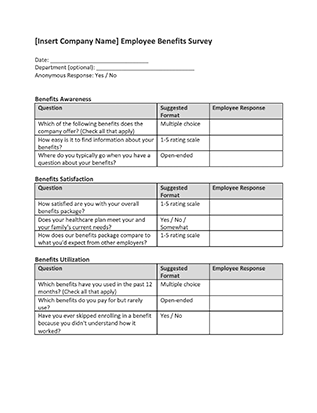
Benefits Awareness Questions
Employees can’t use benefits they don’t know about. These questions test whether your team understands what’s available to them, revealing key communication gaps.
- Which of the following benefits does the company offer?
- How easy is it to find information about your benefits?
- Where do you typically go when you have a question about your benefits?
Benefits Satisfaction Questions
These questions measure satisfaction with your benefits package as a whole, then break it down by category.
- How satisfied are you with your overall benefits package?
- Does your healthcare plan meet your and your family’s current needs?
- How does our benefits package compare to what you’d expect from other employers?
Benefits Utilization Questions
Utilization questions reveal which benefits employees use on a regular basis. This data is especially useful when you’re negotiating with your broker or reallocating budget.
- Which benefits have you used in the past 12 months?
- Which benefits do you pay for but rarely use?
- Have you ever skipped enrolling in a benefit because you didn’t understand how it worked?
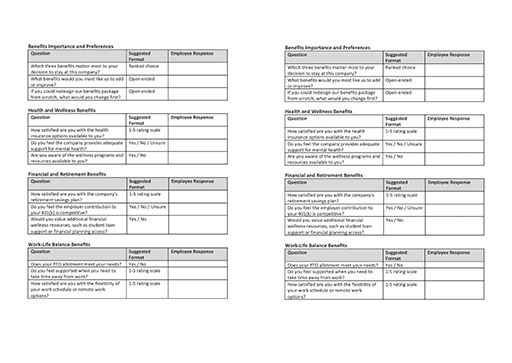
Benefits Importance and Preferences Questions
These questions show what employees value most, and what’s missing from your current lineup. Segment results by tenure, age range, or department to get a more complete picture.
- Which three benefits matter most to your decision to stay at this company?
- What benefits would you most like us to add or improve?
- If you could redesign our benefits package from scratch, what would you change first?
Health and Wellness Benefit Questions
These questions focus on health insurance, mental health coverage, and wellness programs.
- How satisfied are you with the health insurance options available to you?
- Do you feel the company provides adequate support for mental health?
- Are you aware of the wellness programs and resources available to you?
Financial and Retirement Benefit Questions
This section covers 401(k) plans, financial wellness programs, and compensation-adjacent benefits.
- How satisfied are you with the company’s retirement savings plan?
- Do you feel the employer contribution to your 401(k) is competitive?
- Would you value additional financial wellness resources, such as student loan repayment or financial planning support?
Work-Life Balance Benefit Questions
These questions cover PTO, flexible work, parental leave, and remote work support. For many mid-career employees, these benefits rank above salary increases when they decide whether to stay or go.
- Does your PTO allotment meet your needs?
- Do you feel supported when you need to take time away from work?
- How satisfied are you with the flexibility of your work schedule or remote work options?
Free Employee Benefits Survey Template
Ready to run your own survey? Paycor’s free employee benefits survey template includes pre-loaded questions across every category above, so you don’t have to start from scratch.
The template includes:
- Ready-to-use questions covering awareness, satisfaction, utilization, and preferences
- Clear instructions for editing and customizing each section
- Suggested question formats, including rating scales, multiple choice, and open-ended prompts
How to Analyze and Act on Benefits Survey Results
Collecting responses is just the first step. Here’s how to turn survey results into a benefits strategy.
- Rank benefits by response frequency: Start with the benefits employees mention most often, whether that’s in the utilization, satisfaction, or preference questions.
- Segment by demographics: Break results down by department, tenure, age range, or other relevant categories. If you just average results across your whole workforce, you can miss the needs of individual employees.
- Spot the awareness vs. utilization gap: High utilization paired with low satisfaction points to a problem with the benefit itself. Low utilization paired with high awareness points to a communication problem, not a benefits problem.
- Bring the data to your broker: Use utilization and satisfaction data as evidence when you negotiate renewals. Specific numbers carry more weight than a general sense that employees seem unhappy with their health plan.
How Paycor Simplifies Benefits Administration
Once you know what employees want, Paycor’s benefits administration tools empower you to support them. Manage open enrollment, update your benefits offerings based on survey data, and communicate changes to employees, all from the same HCM platform you use for payroll and HR.