









HR’s Free, Customizable Template
Workforce planning sounds straightforward in theory. In practice, it’s a constant balancing act. Headcount needs shift. Business priorities change. It’s hard enough to evaluate skills gaps…and then you have to close them.
That’s where our template comes in. A solid workforce planning template gives HR and company leaders a shared framework to align on strategy, forecast headcount, and manage day-to-day staffing needs, all in one place. Download yours here, and use the tips in this article to make the most of it.
What Are Workforce Planning Templates?
A workforce planning template is a structured document that helps HR and the C-suite assess the current workforce, identify future needs, and build a plan to close the gap. Think of it as a shared starting point: one place where strategy, headcount, and operational details all come together.
Templates vary in scope and format. Some focus on long-term talent strategy. Others zero in on headcount forecasting or day-to-day staffing logistics. The most effective, helpful templates cover all three, so nothing falls through the cracks.
Why Use Workforce Plan Templates?
Without a template, the workforce planning process tends to stall. Everyone agrees it’s important, but unless you have a shared structure, it’s hard to move from discussion to decisions.
A good template keeps your team accountable and helps leaders build momentum. It prompts the right questions, keeps stakeholders aligned, and creates a paper trail you can revisit as business conditions change. Instead of starting from scratch every planning cycle, you have a repeatable framework that gets sharper over time.
For HR, templates also facilitate conversations with finance and leadership. Organized data empowers you to make a much stronger case for the headcount, budget, or training investments your team needs.
Benefits of Using a Workforce Planning Template
A workforce planning template does more than keep your files organized. When HR uses one consistently, it touches almost every part of the people strategy. Here are the biggest benefits.
Better Alignment Across Teams
Workforce planning only works when HR, finance, and company leaders are working from the same set of assumptions. A shared template makes that possible. Everyone can see the same data, challenge the same projections, and sign off on the same plan.
Faster, More Confident Decision-Making
When your workforce data is organized and skill gaps are clearly documented, you can make decisions more quickly. Instead of scrambling to pull numbers together before a leadership meeting, HR can walk in prepared.
A Repeatable Process
If you’re writing a workforce plan from scratch every fiscal year, you’re leaving money on the table. A template gives you a consistent framework to build on, so each planning cycle builds on what you learned in the previous one.
Fewer Surprises
Reactive hiring is expensive, and unexpected turnover is disruptive. A workforce planning template helps you spot risks before they become problems, whether that’s a looming skills gap, a flight risk in a key department, or a headcount mismatch heading into a busy season.
Stronger Cases for Investment
HR often struggles to get budget approved for the people initiatives that matter most. A well-documented workforce plan backs up your proposal with hard data, empowering you to justify any headcount additions, training programs, or compensation adjustments to the C-suite.
The Best Workforce Planning Templates to Use
Not all workforce planning templates serve the same purpose. Make sure you choose the right template for your specific goals, whether you’re planning to set a multi-year talent strategy, project next quarter’s headcount, or optimize your day-to-day labor spend. Here are the three templates every HR team should have in their toolkit.
Strategic Workforce Planning Template
A strategic workforce planning template takes the long view. It’s designed to help HR and the C-suite map out where the business is headed and what people and skills you’ll need to get there. These templates typically include a current-state assessment of your workforce, a future-state vision tied to business goals, a gap analysis comparing the two, and a high-level action plan for closing those gaps through hiring, development, or restructuring.
This template is most useful during quarterly or annual planning cycles, major business pivots, or any time leadership is making major decisions.
Headcount Workforce Planning Template
A headcount planning template gets more granular. Where the strategic template sets direction, the headcount template tracks the details: open roles, planned hires, attrition projections, and budget impact. HR teams use it to build the business case for new positions, monitor hiring progress against targets, and keep finance aligned on people costs throughout the year.
This one tends to live in a spreadsheet and be updated whenever your headcount changes, not just on a quarterly or annual cadence.
Operational Workforce Plan Template
An operational workforce plan template focuses on the here and now. It helps managers and HR ensure the right people are in the right roles at the right time, addressing issues like shift coverage, workload distribution, and short-term staffing adjustments. It’s less about long-term strategy and more about keeping daily operations running smoothly.
What Is Included in the Paycor Workforce Planning Template?
Paycor’s workforce planning template is built to cover all three planning dimensions: strategy, headcount, and operations. Instead of juggling multiple documents, HR and company leaders can work from a single, cohesive resource. Here’s what’s inside:
Current Workforce Assessment
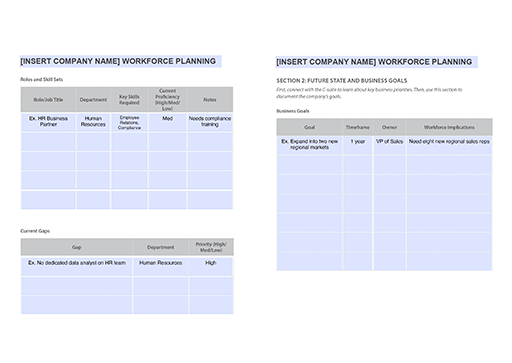
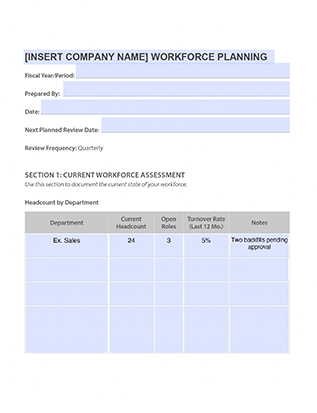
Before you can plan where you’re going, you need a clear picture of where you are. This section helps HR document current headcount, roles, skill sets, and any gaps that need to be addressed.
Future State and Business Goals
This section connects workforce planning to business strategy. Use it to document where the company is headed and what talent, skills, and headcount you’ll need to support that growth.
Gap Analysis
Once you’ve identified your current state and your future needs, the gap analysis section helps you identify exactly what’s missing. This is where HR should list specific skills, headcount in key departments, or roles that don’t yet exist.
Headcount Planning
Track open roles, planned hires, attrition projections, and budget impact in one place. This section keeps HR and finance aligned throughout the year, not just during planning season.
Operational Staffing Plan
Day-to-day workforce management gets its own section. Use it to document shift coverage, workload distribution, and short-term staffing adjustments so managers always know where things stand.
Action Plan
Strategy without execution is just a document. The action plan section helps HR translate gap analysis findings into concrete next steps, with clearly defined owners, timelines, and priorities.
How to Use the Workforce Planning Template
Are you ready to start the workforce planning process? Download our free template and follow these steps to get started.
1. Gather Your Baseline Data
Before you fill in the template, gather information from your HCM platform. For instance, you might pull current headcount by department, open roles, recent attrition rates, and any skills assessments HR has on file. The more complete your starting point, the more useful the rest of the template will be.
2. Align With the C-Suite on Business Goals
Workforce planning doesn’t happen in a vacuum. Before HR can assess gaps or build a headcount forecast, you need to know where the business is headed. Schedule time with company leaders to get clarity on growth targets, new initiatives, and any planned changes to the org structure.
3. Complete the Current State Assessment
With your baseline data in hand, fill out the current workforce assessment section. Document headcount, roles, and skill sets across departments. This section will inform your to-do list (and help you close them!).
4. Define Your Future State
Use the business goals you’ve aligned on to map out your staffing goals. Describe how you’ll need the workforce to look in six months, one year, or three years. Think about the roles, skills, and headcount required to support the company’s medium- and long-term goals.
5. Run the Gap Analysis
Compare your current state to your future state. What’s missing? Flag specific skill gaps, under-resourced departments, and roles that need to be built out. This is where the plan starts to take shape.
6. Build the Headcount Plan
Translate your gap analysis into a concrete hiring plan. Document open roles, planned hires, expected attrition, and budget implications. Share this section with finance early to get alignment.
7. Document the Operational Staffing Plan
Zoom in on short-term needs. Are there coverage gaps as you head into a busy season? Workload imbalances across teams? Use the operational section to address your immediate goals for the next 30, 60, or 90 days.
8. Assign Owners and Set Timelines
Accountability drives results. Assign a specific owner and a realistic deadline to every action item listed in the above sections. This step turns your workforce plan into a working document rather than a one-time exercise.
9. Revisit and Update Regularly
Workforce plans aren’t set-it-and-forget-it. Schedule regular check-ins to update headcount figures, revisit the gap analysis, and adjust the action plan as business conditions change.
Download Your Workforce Planning Template Today
Your workforce plan starts here. Download Paycor’s free template to prepare your whole team for the future.
Workforce Planning Template FAQs
Got questions about the workforce planning template? Here are the answers you need.
Can I edit the workforce plan template?
Yes. The template is fully customizable, so you can adjust any section to fit your company’s specific needs. Use it as an example to get started, then tailor it to reflect your unique workforce, goals, and planning process.
Is the workforce and staff planning template free?
Yes. Paycor’s workforce planning template is completely free to download and use.
In what format is the workforce planning template available?
The template is available as an editable PDF.
How will using the staff plan template help me?
A workforce planning template helps HR and company leaders get organized around two of the most time-sensitive priorities in people management: strategy and headcount. With a clear framework in place, it’s easier to align with the C-suite, build a business case for new hires, and stay ahead of workforce changes before they become problems.
Can I print the template for physical use?
Yes. The PDF is print-ready, so you can use it in meetings, planning sessions, or anywhere you prefer to work on paper.