









When business challenges arise, companies often need to reduce workforce costs. Two common approaches, furloughs and layoffs, sound similar but have very different implications for employers and employees. Understanding these differences helps HR professionals make informed decisions while maintaining compliance and treating employees fairly.
The fundamental question: Does the employee still have a job? The answer to this question determines everything from benefits to unemployment eligibility.
What is a Furlough?
A furlough is a temporary, unpaid leave of absence or reduction in hours where employees keep their employment status. Employees don’t receive regular wages but remain on the company’s payroll with the expectation of returning when conditions improve.
Furloughs can include:
- Zero-hour furloughs: No scheduled work hours for a specified period
- Reduced-hour furloughs: Working fewer hours (e.g., 30 instead of 40 per week)
- Rolling furloughs: Rotating unpaid leave among employee groups
How Do Furloughs Work?
Employers set furlough terms based on business needs and financial constraints. The duration typically aligns with anticipated recovery timelines. Employees often keep certain benefits, particularly health insurance, depending on company policy and furlough length.\
What is a Layoff?
A layoff is the permanent or indefinite termination of employment due to business needs, not employee performance. Reasons for layoffs include economic downturns, restructuring, mergers, or facility closures.
When laid off, the employment relationship ends completely. Employees stop receiving wages, lose benefits (though COBRA may apply), and have no guarantee of rehiring.
How Do Layoffs Work?
Employers identify positions to eliminate based on business criteria like departmental needs, seniority, or job function. Laid-off employees may receive severance packages, though they’re not legally required in most cases.
Note: Federal and state laws often require advance notice, especially for mass layoffs
What is the Difference Between Furloughs and Layoffs?
The core difference: Furloughed employees remain employed; laid-off employees do not.
Furloughs are temporary cost-saving measures that preserve the workforce. Layoffs represent permanent separation necessary for long-term workforce reductions.
For employees, furloughs offer continued employment status and potential benefits retention, while layoffs mean finding new employment. Both, however, are different from a reduction in force.
Furlough vs Layoff: Key Differences
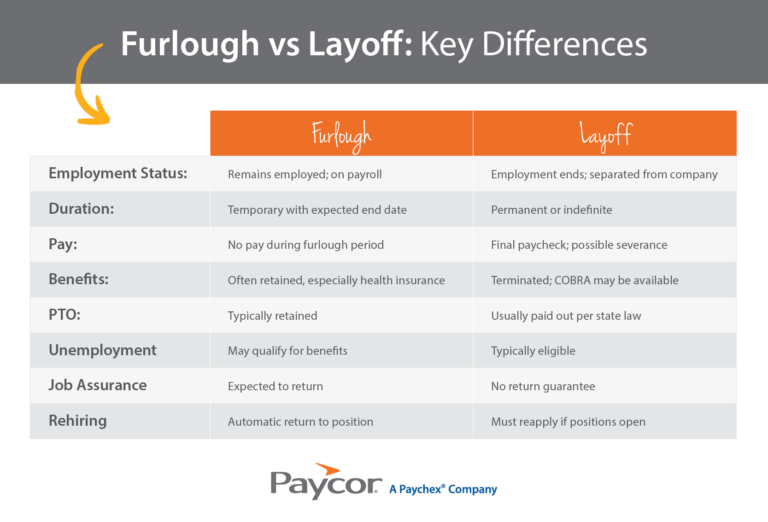
Duration
Furloughs are temporary, typically lasting weeks to months with intent to bring employees back. Furloughs exceeding six months may trigger WARN Act requirements. Layoffs are permanent workforce reductions, though some seasonal industries may rehire without guarantees.
Pay
Furloughed employees receive no wages but remain employed. Laid-off employees receive a final paycheck with earned wages, and possibly severance.
Employee Engagement & Retention
Furloughs signal company commitment to employees, potentially maintaining loyalty and enabling quick recovery when conditions improve. Layoffs can damage morale among remaining staff, hurt the employer brand, and lead to voluntary turnover of high performers.
Rehiring Process
Furloughed employees return automatically with no recruiting or training costs. Laid-off employees must go through the full hiring process if positions become available.
Healthcare Benefits
Many companies continue health insurance for furloughed employees. Laid-off employees lose coverage but may access COBRA at their full expense, often making it unaffordable.
PTO
Furloughed employees keep their accrued PTO. Laid-off employees typically receive PTO payouts based on state law, which proper HR software helps manage.
Unemployment
Both groups may qualify for unemployment benefits, though eligibility varies by state. Laid-off employees typically qualify immediately while furloughed employees’ eligibility depends on state rules.
Job Assurance
Furloughed employees have a strong expectation of returning to their positions when the furlough ends, providing psychological and financial security during uncertain times. Laid-off employees have no such guarantee. Their positions may be permanently eliminated or filled by other candidates, requiring them to seek new employment opportunities.
The WARN Act
The Worker Adjustment and Retraining Notification (WARN) Act requires employers with 100+ employees to provide 60 days’ notice for mass layoffs affecting 50+ workers.
Furloughs under six months generally don’t trigger WARN requirements.
Furloughs extending beyond six months may require notice. Many states have mini-WARN laws with varying requirements. Non-compliance results in penalties including back pay. Compliance solutions help navigate these complex requirements.
Furloughs vs Layoffs: The Pros and Cons
Both furloughs and layoffs offer distinct advantages and challenges. Understanding these trade-offs helps HR leaders make informed decisions that balance financial needs with workforce preservation and organizational culture.
Pros and Cons of Furloughs
| Pros | Cons |
| Preserves trained workforce for recovery | Creates employee uncertainty and financial stress |
| Avoids recruiting and training costs | May convert to layoffs if conditions don’t improve |
| Maintains institutional knowledge | Administrative complexity managing benefits and compliance |
| Enables faster business recovery | Limited immediate cost savings |
| Demonstrates commitment to employees | Can damage morale among remaining staff |
| Benefits often retained for employees | May still trigger WARN Act if extended |
Pros and Cons of Layoffs
| Pros | Cons |
| Immediate, substantial cost reduction | High severance and benefit costs |
| Addresses permanent structural changes | Loss of institutional knowledge and skills |
| Simplifies operations and workforce | Expensive rehiring when business improves |
| Allows organizational restructuring | Damages employer brand and morale |
| Provides closure for company and employees | Legal risks if not handled properly |
| May include severance for departing employees | Voluntary turnover of top talent may increase |
Furlough vs. Layoffs: How to Decide Which One to Use
Choosing between furloughs and layoffs requires careful analysis of your specific circumstances. Here are a few things you should do to make your decision:
Assess the Financial Situation and Timeline
If financial challenges are temporary (3–6 months) with expected recovery, furloughs preserve your workforce. If facing permanent changes or long-term challenges, layoffs may be necessary to align workforce with new business realities.
Evaluate Critical Skills and Talent Retention
Employees with specialized skills or critical institutional knowledge are difficult and expensive to replace. In tight labor markets, furloughs protect your competitive advantage by keeping talented team members connected.
Consider Legal and Compliance Requirements
Review WARN Act obligations and state-specific requirements. Leverage compliance solutions to navigate complex regulations successfully.
Analyze Impact on Company Culture
Consider how each option affects organizational culture and employee morale. Furloughs often signal commitment to employees, while prolonged uncertainty can be equally demoralizing.
Calculate Total Costs
For furloughs: You should consider costs associated with benefits continuation, administration, potential unemployment rate increases, and possible conversion costs.
For layoffs: You need to consider the severance, unemployment insurance, future recruiting, hiring, training, and productivity losses during transition.
How to Handle Furloughs and Layoffs
Successfully managing workforce reductions requires careful planning, clear communication, and attention to compliance. Whether implementing furloughs or layoffs, these best practices help protect your organization while treating employees with dignity and respect.
Furlough Best Practices
- Create clear written policies outlining terms, duration, benefits, and return process
- Communicate early and often with transparency about business reasons and timelines
- Provide written documentation covering all critical details
- Maintain benefits where feasible to support employees during uncertainty
- Set clear work boundaries to avoid wage and hour violations
- Support resources including unemployment guidance and assistance programs
Layoff Best Practices
- Follow structured selection using objective, documented criteria
- Provide adequate notice per WARN Act and state requirements
- Conduct professional meetings with dignity and clear explanations
- Offer severance and support including outplacement services
- Prepare complete documentation covering final pay, COBRA, and benefits
- Address remaining employees with honest communication about the future
Communicating Both Furloughs and Layoffs
How you communicate workforce reductions matters as much as the decision itself. Clear, compassionate messaging protects your employer brand while helping employees navigate difficult transitions.
Provide Early Notification
Give maximum advance notice to allow employees time to prepare financially and emotionally, update resumes, and access support resources.
Be Completely Transparent
Explain business reasons clearly without sugarcoating. Acknowledge emotional impact and validate employees’ feelings with empathy.
Discuss Benefits and Unemployment
Provide detailed information about benefits continuation, COBRA eligibility, unemployment filing, and any severance packages.
Offer Networking Support
Help departing employees with outplacement services, reference letters, LinkedIn recommendations, and professional networking connections.
Maintain Compliance
Ensure compliance with WARN Act, anti-discrimination laws, COBRA notifications, final paycheck requirements, and benefits regulations using workforce management solutions.
How Paycor Helps During Furloughs and Layoffs
Managing workforce reductions requires administrative precision and compliance expertise. Paycor’s HCM software provides the tools HR professionals need to manage furloughs and layoffs efficiently:
- HR Software: Streamline documentation, generate notifications, and maintain consistent policies across your organization.
- Compliance Solutions: Navigate WARN Act obligations, state-specific requirements, and benefits regulations.
- Benefits Administration: Manage benefits transitions for furloughed employees or facilitate COBRA enrollment for laid-off workers.
- Workforce Management: Track furloughed employee status, manage reduced schedules, and plan return-to-work scenarios.
- Talent Management: Support long-term talent strategy whether preserving workforce or planning future hiring.
- Reporting and Analytics: Make data-driven decisions with comprehensive workforce cost analysis and scenario planning.
Manage Furloughs and Layoffs with Paycor
Workforce reductions are difficult decisions that require the right tools for compliant, humane execution. Paycor’s platform provides streamlined workflows, compliance guidance, communication tools, and integrated HR, payroll, and benefits management.
Take a guided tour of Paycor’s platform to see how our solutions help you manage workforce changes effectively while maintaining compliance and preserving your employer brand.
Is it better to be furloughed or laid off?
Furloughs are generally preferable for employees. Employment continues, benefits often remain, and there’s an expectation of returning to work; however, furloughs create uncertainty about timing. Some employees prefer layoffs with severance for the clarity to move forward with job searching.
How long can a company furlough an employee?
No strict legal limit exists, but furloughs exceeding six months may trigger WARN Act requirements. Extended furloughs damage employee trust and employee retention. If furloughs extend beyond 3–6 months, reassess whether permanent layoffs would be more appropriate.
Are furloughs and layoffs the same?
No. Furloughs are temporary unpaid leave with continued employment status and expectation of return. Layoffs are permanent termination with no return guarantee. This distinction affects benefits, unemployment eligibility, and job security.
Can an employee quit while on furlough?
Yes, furloughed employees can resign anytime but employees who quit generally aren’t eligible for unemployment benefits, so this should be carefully considered before resigning.
Can an employee be terminated while on furlough?
Yes, employers can terminate furloughed employees, converting the furlough into a layoff. This might occur if business conditions worsen or if there are performance issues. Proper notice and WARN Act compliance may apply.
Why would a company choose layoffs over furloughs?
Companies choose layoffs when facing permanent financial challenges, eliminating positions due to restructuring, requiring immediate substantial cost reduction, or when prolonged furloughs would be unfair to employees.
Why would a company choose furloughs over layoffs?
Companies implement furloughs to preserve trained workforce during temporary downturns, avoid recruiting and training costs, maintain institutional knowledge, position for quick recovery, and demonstrate employee commitment.