









Human resources compliance is one of the most important and complex responsibilities HR teams manage. Between federal laws, state requirements, industry regulations, and internal policies, organizations must protect employees while minimizing legal and financial risk.
This guide breaks down the fundamentals of HR compliance, explains key regulations, highlights common challenges, and offers steps to strengthen your HR compliance across every function.
What Is HR Compliance?
HR compliance is the process and procedure organizations use to ensure they adhere to all state, federal, and local employment-related laws, regulations, and standards. It includes everything from hiring and payroll to safety, benefits, and termination.
The Importance of HR Compliance
HR compliance ensures that organizations follow all employment-related laws and regulations designed to protect workers and employers. Maintaining compliance helps prevent:
- Lawsuits
- Financial penalties
- Audits
- Workplace disputes
It also builds trust among employees by promoting fairness, transparency, and safety. Because employment laws evolve frequently—and vary widely from state to state—HR teams must continuously update policies, train managers, and monitor processes to remain compliant.
Types of HR Compliance
Compliance in human resources spans several categories, each covering various legal and organizational obligations. The three main types of HR compliance are:
Regulatory HR Compliance
Regulatory compliance refers to an organization’s obligation to follow all federal, state, and local employment laws. These regulations govern areas such as payroll, hiring, benefits, safety, and workplace protections. Staying aligned with these rules is important to minimize legal and financial exposure.
Statutory HR Compliance
Statutory compliance refers to rules an employer must follow because they are mandated by law. These obligations include payroll tax withholdings, workers’ compensation requirements, wage and hour laws, state leave laws, and more. Failure to meet statutory compliance can result in fines, audits, or legal action.
Contractual HR Compliance
Contractual compliance refers to the obligations an employer must uphold under employment contracts, collective bargaining agreements, vendor contracts, or benefit plan documents. This type of compliance is key to building trust, maintaining consistency, and providing transparency with employees and partners.
What is the Role of HR in Compliance?
HR plays a role in ensuring organizations follow employment regulations and internal policies.
HR teams build compliant hiring processes and oversee accurate payroll and employee classification. They also track required trainings and help ensure workplace safety standards are met.
When issues arise, HR educates managers, conducts HR audits, and enforces corrective actions. A proactive HR team serves as a safeguard for the organization, helping leaders stay informed while mitigating compliance risk.
HR Compliance Laws HR Must Follow
HR professionals are required to navigate numerous federal and state laws that govern nearly every aspect of employment.
These laws affect hiring, payroll processing, safety, benefits, classification, recordkeeping, and termination. Because regulations and laws vary by state—and often change—HR teams must consistently monitor updates and adjust processes accordingly.
HR Compliance Regulations
A wide range of state-level regulations govern pay, leave, hiring, scheduling, employee documentation, and more.
Below are some of the most important HR compliance regulations organizations must follow:
- Background check requirements
- Drug testing rules
- Employee classification regulations
- Final paycheck laws
- I-9 documentation requirements
- Paid sick leave requirements
- Pay frequency regulations
- Pay transparency mandates
- State paid family leave laws
- State wage-and-hour laws
HR Compliance Laws
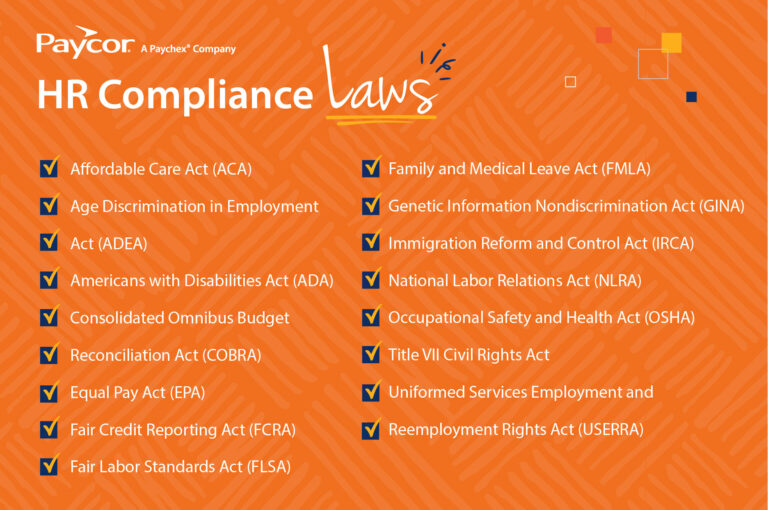
HR professionals must understand a wide range of federal employment laws to help ensure fair treatment, protect employee rights, and reduce the risk of costly legal issues. These laws govern everything from wages and leave to discrimination, safety, and benefits. Below is a summary of the most important HR compliance laws employers must follow, along with a brief explanation of each.
- Affordable Care Act (ACA): Establishes employer shared-responsibility rules, reporting requirements, and coverage standards for health insurance.
- Americans with Disabilities Act (ADA): Protects individuals with disabilities from discrimination and requires employers to provide reasonable accommodations.
- Age Discrimination in Employment Act (ADEA): Prohibits discrimination against workers age 40 and older in hiring, promotion, pay, and other terms of employment.
- Consolidated Omnibus Budget Reconciliation Act (COBRA): Ensures employees and dependents can continue health insurance coverage after qualifying life events or job loss.
- Equal Pay Act (EPA): Requires employers to pay men and women equally for performing substantially equal work under similar conditions.
- Fair Credit Reporting Act (FCRA): Regulates how employers conduct background checks and requires disclosure, authorization, and adverse-action procedures.
- Fair Labor Standards Act (FLSA): Establishes federal minimum wage, overtime rules, recordkeeping requirements, and child labor standards for most employees.
- Family and Medical Leave Act (FMLA): Guarantees eligible employees up to 12 weeks of unpaid, job-protected leave for qualified family and medical situations.
- Genetic Information Nondiscrimination Act (GINA): Prevents employers from using genetic information in employment decisions or requesting genetic data.
- Immigration Reform and Control Act (ICRA): Requires employers to verify employee identity and work authorization through the Form I-9 process and prohibits hiring unauthorized workers.
- National Labor Relations Act (NLRA): Protects the rights of employees to engage in collective bargaining, union activity, and other concerted workplace actions.
- Occupational Safety and Health Act (OSHA): Requires employers to maintain a safe workplace, follow safety standards, and report injuries and hazards.
- Uniformed Services Employment and Reemployment Rights Act (USERRA): Protects the employment and benefit rights of individuals who serve in the military or reserves.
- Title VII – Civil Rights Act: Prohibits workplace discrimination based on race, color, religion, sex, or national origin and governs harassment and retaliation claims
- State-specific wage, leave, and transparency laws: Includes state-mandated rules for minimum wage, paid sick leave, family leave, wage notices, final paychecks, and pay transparency.
HR Compliance Issues and Challenges
HR teams face frequent compliance challenges, especially as workplace regulations change. Below are a few examples of areas that HR might experience issues:
Background Checks
Employers must follow FCRA, comply with “ban-the-box” laws, and ensure background checks are conducted fairly. The best way to do this is to evaluate hiring and onboarding practices and make adjustments, if necessary, to stay compliant.
Employee Classification
HR must ensure they properly classify employees as exempt or non-exempt (contractors). Misclassification can result in payment of back wages or legal action, which can lead to more significant fines and damages.
Note: States may have additional tests beyond federal standards to determine whether workers are employees or independent contractors.
FMLA
Tracking FMLA eligibility, leave usage, and return-to-work processes is another area in which compliance issues can arise. Even the smallest missteps can lead to claims of interference or retaliation.
To stay compliant, employers can create effective leave policies that take into account their states laws and requirements.
Form I-9
Employers must verify work eligibility for every new hire and follow strict document retention and completion timelines. Errors in document completion or retention can lead to serious fines.
More guidance on how to stay compliant can be found in Paycor’s I-9 FAQs.
Immigration Laws
IRCA and federal regulations require employers to verify work eligibility while also avoiding discriminatory recruiting and hiring practices.
Non-discrimination
Discrimination violations can lead to lawsuits and EEOC investigations, which is why employers and HR leaders need to ensure compliance with Title VII, ADA, ADEA, and other laws that require equal treatment for applicants and employees.
Pay Transparency
Certain states require that salary ranges be included on job posting or be disclosed upon request. Because these laws are becoming increasingly more common, HR needs to follow the requirements in the states where they operate.
Pay Equity
Employers must provide equal pay for equal work, and HR must review compensation regularly to identify inequities. If inconsistencies are present, HR leaders should conduct a pay equity audit to determine if there are other, larger discrepancies.
Employee Records
HR must maintain accurate records for payroll, benefits, training, and employee documentation, following strict retention rules.
Sick Leave
States and municipalities may mandate minimum sick leave accrual rates, usage rules, carryover allowances, and employee eligibility. To remain compliant with these regulations, HR should stay up to date on changes within the states they operate in.
Termination Laws
Improper termination can result in claims of wrongful discharge or discrimination. HR must document performance concerns, follow established procedures, and ensure compliance with federal and state laws.
Union Laws
Under the NLRA, employees have the right to engage in collective activities. To stay compliant, employers must avoid interfering with these rights.
Wage and Hour Laws
Wage and hour rules define minimum wage, overtime obligations, meal and rest break requirements, and recordkeeping standards beyond federal law.
To stay compliant, employers must make sure that employees are paid accurately and on time according to federal and state requirements. Mistakes in overtime, exempt classification, or meal/rest breaks can result in costly penalties.
Workers’ Compensation
Employers must maintain workers’ comp coverage, report incidents promptly, and follow state rules. Solutions like Paycor Workers’ Compensation help organizations stay aligned.
How to Improve HR Compliance:
Human resource departments can strengthen compliance by taking a proactive and systematic approach. Here are a few steps that HR teams can follow to reduce risk:
- Document all HR workflows, policies, and procedures.
- Conduct regular internal compliance audits.
- Train managers frequently on employment laws and policy expectations.
- Centralize employee data to improve accuracy and consistency.
- Monitor state and federal law updates on a recurring basis.
- Standardize hiring, onboarding, and payroll processes.
- Use checklists to track compliance-related tasks.
- Implement an incident reporting process for workplace issues.
- Review employee classifications annually.
- Maintain detailed records of performance, pay, and training.
- Use technology to automate and monitor compliance-related activities.
How Paycor Helps with HR Compliance
Paycor is an HCM technology provider that helps HR leaders create, manage, and maintain compliance across the entire employee lifecycle. Paycor’s HR & Payroll Solutions centralize employee data, automate pay calculations, and track record-keeping requirements. And our compliance solutions help organizations stay aligned with federal and state regulations, offering alerts, guidance, and automated workflows.
Paycor’s HCM Software also supports hiring compliance through structured processes, including tools such as our Onboarding Software that help ensure documentation is completed accurately and consistently.
For healthcare and benefits compliance, ACA Solutions simplify reporting and year-end requirements. And additional resources—such as state law libraries and compliance checklists—make it easier for employers to stay ahead of regulatory changes.
Build Your HR Compliance Program with Paycor
HR compliance can be complicated, but Paycor offers the software, tools, and insights you need to stay ahead. From payroll accuracy to hiring practices to records management, Paycor’s all-in-one HCM provides HR teams with the technology they need to operate confidently and compliantly.
Take a guided tour today!
HR Compliance FAQs
Have more questions about HR Compliance? Read on!
What is Statutory HR Compliance?
Statutory HR compliance refers to the employer obligations required by law, including payroll taxes, wage-and-hour rules, state-specific leave laws, and reporting obligations.
Who is Responsible for HR Compliance?
HR plays a central role, but compliance is a shared responsibility across leadership, managers, legal teams, and employees who must follow established policies and procedures.
How Do You Ensure HR Compliance?
Compliance is achieved by documenting processes, training managers, conducting audits, monitoring law changes, centralizing employee data, and using technology to automate and track compliance workflows.