









When it comes to compensating employees, choosing a pay period is just as important as the amount they earn. Set the wrong pay schedule, and you’ll have unhappy workers, budget problems, and maybe even compliance issues.
But when you understand the different types of pay periods, it gets easier to pick the right one for your business.
Let’s take a look at how pay periods work, the seven types of pay periods, and how to pick the best fit for your team.
What Is a Pay Period?
A pay period is the amount of time for which an employer pays its workers. It has a defined start date and end date. When the pay period closes, HR processes payroll, and employees receive their wages for that window of work.
Pay periods repeat on a set schedule throughout the year. That schedule determines how many paychecks employees receive and how often your team has to run payroll.
How Do Pay Periods Work?
Each pay period has a start date, an end date, and a pay date. When the pay period closes (on the end date), HR collects time and attendance data, calculates gross pay, applies deductions and tax withholdings, and prepares direct deposits or checks.
Here’s a simple example:
Say your company runs biweekly pay periods. The first period opens January 1st and closes January 14th. On January 15th, HR processes payroll, and employees receive their wages a few days later, on January 20th.
The second pay period opens on January 16th and will stay open until January 30th. The cycle repeats throughout the year. The more often you run payroll, the more often you’ll have to go through each of the steps above.
Pay Periods vs. Pay Dates
Employees care about both pay periods and pay dates. They want to know exactly what they’re being paid for, and when their wages will hit their account.
But people often confuse pay periods with pay dates, even though they mean entirely different things. A pay period is the window of time worked, for which the employee will get paid. A pay date is the day the employee actually receives their wages.
Note: There’s almost always a gap between the last day of the pay period and the employee’s pay date. This is because HR needs this time to process payroll and send funds to employees; the process usually takes a few days.
In the above example, the pay period closed on January 14th, but employees weren’t paid until January 20th.
7 Different Types of Pay Periods
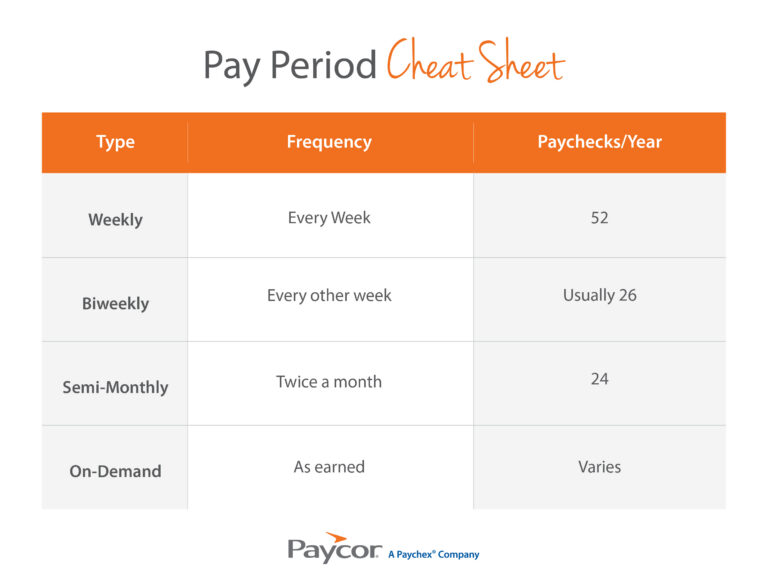
There’s no universal pay schedule that works for every business. Here’s a breakdown of the seven types of pay periods, including the pros and cons of each.
1. Weekly
Employees are paid once a week, resulting in 52 paychecks per year.
| Pros | Cons |
|---|---|
| Popular with hourly and shift workers who want frequent access to wages Simplifies overtime tracking Gives workers more financial flexibility | HR processes payroll 52 times/year, leading to a higher administrative burden Many payroll provider charge per cycle |
2. Biweekly
Employees are paid every other week, resulting in 26 paychecks per year.
| Pros | Cons |
|---|---|
| Predictable and consistent. As of 2023, this was the most common pay schedule in the U.S. (Bureau of Labor Statistics) Easier to administer than weekly payroll | Two months per year include three pay periods, which can complicate cash flow planning Once every ~11 years, employers need to plan for a 27th pay period |
3. Semi-Monthly
Employees are paid twice a month on fixed dates (typically the 1st and 15th or the 15th and the last day of the month), resulting in 24 paychecks a year.
| Pros | Cons |
|---|---|
| Fixed pay dates are easy to communicate and plan around Aligns well with monthly expenses like rent and loan payments Fewer processing cycles than biweekly pay | Pay periods don’t always align with the standard workweek, which can complicate overtime calculations Employees receive fewer paychecks per year than biweekly Can be confusing for employees switching from a biweekly schedule |
4. Monthly
Employees are paid once a month, resulting in 12 paychecks per year. Pay is typically issued on the last business day of the month or the first business day of the following month.
| Pros | Cons |
|---|---|
| The least expensive and least time-consuming pay schedule for HR Simplifies payroll tax reporting and accounting Works well for salaried employees with predictable compensation | The hardest pay schedule for employees to manage, especially those living paycheck to paycheck Long gaps between pay can lower moraleProhibited in certain states; make sure to check which laws apply to your business |
5. Fixed-Length Pay Periods
A fixed-length pay period runs for a set number of days, regardless of where those dates fall on the calendar. For example, a 10-day cycle doesn’t align with standard weekday patterns.
| Pros | Cons |
|---|---|
| Consistent period length regardless of how many days are in the month Useful for businesses with rotating schedules | Pay dates shift across the calendar, which can confuse employees Harder to align with standard accounting or tax reporting periods Requires clear, ongoing communication from HR |
6. Custom Pay Periods
Some businesses design pay schedules that don’t fit any of these standard categories. Custom pay periods could vary by department, job type, or employment classification, for example.
| Pros | Cons |
|---|---|
| Can be tailored to fit specific operational needs or industry norms Gives employers flexibility to accommodate different types of workers | Significantly more complex for administrators Higher risk of payroll errors and compliance problems Harder to communicate to employees |
7. Instant Pay Periods
On-demand pay (sometimes called earned wage access) lets employees access funds they’ve already earned before their scheduled pay date. This option does not replace traditional pay periods; HR can offer it as a benefit to drive employee retention.
| Pros | Cons |
|---|---|
| Strong recruiting and retention tool, especially for hourly workers Reduces employees’ financial stress without raising payroll costs Builds employer brand | Requires a payroll platform that supports earned wage access Adds complexity to payroll reconciliation Employees need clear policies around how and when they can access funds |
Why Does the Number of Pay Periods Vary?
The number of pay periods in a year depends on which pay schedule you choose. The most common options are:
- Weekly: 52 pay periods
- Biweekly: 26 pay periods (occasionally 27)
- Semi-monthly: 24 pay periods
- Monthly: 12 pay periods
These differences have a huge impact on your workforce. Salaried employees earn the same annual amount regardless of pay schedule, but their per-paycheck amount changes based on how many checks they receive each year. While they’ll earn the same amount annually, their pay frequency affects budgeting, financial wellness, and job satisfaction.
How Are Pay Periods Determined?
Payroll compliance always comes first. Before settling on a pay schedule, HR should review relevant federal, state, and municipal laws. Some states mandate specific pay frequencies for certain employee types, for example.
From there, it’s a balancing act. HR leaders should work with executives to consider industry norms, employee preferences, payroll processing costs, and cash flow. There’s no formula, but most companies land on a schedule that meets legal requirements, works for their team, and doesn’t result in an unnecessary administrative burden.
How to Choose Pay Periods
There is no right or wrong type of pay period, just the best option for your company. Your decision should account for your team’s needs, your industry, and your operational capacity. As you weigh the options and prepare to get approval from the C-suite, consider these issues:
- State Requirements: Check with your legal team to make sure your company is compliant. When choosing a type of pay period, this should be HR’s top priority.
- Your Workforce: Hourly and shift workers generally prefer weekly or biweekly pay. Salaried employees are often more flexible. You can also run a survey to learn about your team’s unique preferences.
- Payroll Processing Costs: Weekly pay is the most expensive option. Monthly is the most affordable. Factor in both time and per-cycle fees from your payroll provider.
- Employee Financial Wellness: More frequent pay gives your workers more financial flexibility, improving morale, retention, and recruiting.
- Overtime Calculations: Weekly and biweekly schedules make it easier for HR calculate overtime pay. Semi-monthly schedules make this more complicated.
- Accounting Alignment: Some businesses prefer semi-monthly pay because it aligns more neatly with their financial reporting.
Note: Changing pay periods is possible. But it’s not simple. It requires communication with employes, updated contracts, and careful coordination.
How Paycor Helps Simplify Pay Periods
Paycor is a leading HCM software provider that helps businesses manage payroll accurately, efficiently, and in compliance with state and federal requirements.
Paycor’s payroll software is built to handle the full complexity of pay period management, with features like:
- Automated payroll processing that runs accurately on whatever schedule you choose: weekly, biweekly, semi-monthly, monthly, or custom
- Tax compliance support so withholdings, deposits, and filings are calculated correctly every pay period
- Direct deposit management so employees are paid on time, every time
- Reporting and analytics to track labor costs, identify trends, and support strategic planning
Whether you’re setting up a payroll calendar for the first time or managing a complex workforce with multiple pay frequencies, Paycor gives HR the tools they need to get payroll right.
Design Your Employee Pay Periods with Paycor
Choosing a pay period is a foundational business decision. Once you decide, you’ll have to live with that choice for a long time. Make sure you weigh your options, consult with your team, and get expert advice before you commit to a specific pay schedule.
Paycor’s HR and payroll solutions make it easy to set up, manage, and adjust pay periods as your business grows. Ready to see our tools in action? Schedule a guided tour.
Pay Period FAQs
Get answers to some of the most common questions HR leaders and business owners have about pay periods.
Can I change a pay period once it’s set?
Yes, but it takes planning. HR needs to communicate changes well in advance and update the contracts for new hires. You’ll also need to coordinate with your payroll provider. Many businesses time the switch to coincide with the start of a new calendar year to avoid complicating tax reporting.
What is the difference between weekly and bi-weekly pay periods?
Weekly pay periods result in 52 paychecks per year, while biweekly pay periods result in 26. Weekly paychecks are smaller and more frequent; biweekly checks are larger and cover two weeks of work. Weekly pay is more expensive to administer but is often preferred by hourly and shift workers.
Is it better to get paid monthly or bi-weekly?
For most employees, bi-weekly pay is preferable. More frequent paychecks make budgeting easier and reduce financial stress. Monthly pay can work well for salaried employees with predictable expenses, but employee satisfaction and state law often make biweekly the more practical choice for employers, too.
Can you have different pay periods for different employees?
Yes, in most cases. Some businesses pay hourly employees weekly while paying salaried employees semi-monthly or monthly. Just make sure your payroll system can handle multiple schedules and that each one complies with your state’s requirements for that employee type.
What happens if an employee starts work in the middle of a pay period?
The employee is paid for the portion of the pay period they worked. Most payroll systems handle the proration automatically, but it’s worth double-checking the first paycheck to confirm its accuracy.