









Many HR teams use “recruitment” and “talent acquisition” interchangeably. But there are several important differences between the two.
The terms describe two distinct approaches to hiring. One fills immediate needs while the other builds sustainable hiring systems. Your organization needs both, but you can’t deploy them effectively until you understand what sets them apart.
This guide explains when and how HR should talent acquisition vs recruitment.
Talent Acquisition vs. Recruitment: The Difference
Talent acquisition and recruitment share the same goal: to fill open positions with qualified people. But the processes are very different.
Recruitment is transactional. A job opens, you post it, screen candidates, conduct interviews, and make an offer. The process starts when you need someone and ends when they accept. It’s reactive hiring designed to solve immediate staffing needs.
Talent acquisition is strategic. You’re building relationships with potential candidates long before positions open. HR continuously works to develop the employer brand, create talent pipelines, and plan for future workforce needs. It’s proactive workforce planning that aligns hiring with business growth.
Think of recruitment as shopping when your fridge is empty. Talent acquisition is meal planning for the month. Both get food on the table, but they function very differently.
Talent Acquisition Basics
Talent acquisition is a continuous, strategic process HR uses to identify, attract, and retain the right people to achieve long-term company goals. Unlike recruitment, which focuses on filling current vacancies, talent acquisition takes a long-term view of workforce planning.
HR builds relationships with potential hires months or even years before a position opens. The process includes employer branding, talent pipeline development, workforce planning, and succession planning. Talent acquisition teams track industry trends, monitor competitors’ hiring patterns, and maintain ongoing communication with high-potential candidates.
A strong talent acquisition strategy can reduce time-to-hire, lower cost-per-hire, and improve candidate quality. When positions open, HR leaders already know where to find qualified people. The pipeline is full, relationships are established, and hiring moves quickly.
HR and Talent Acquisition
In most companies, HR owns the talent acquisition process. The team develops employer branding strategies, builds relationships with universities and professional organizations, and maintains candidate databases. HR also partners with department leaders to forecast future hiring needs and identify skills gaps the organization will need to fill.
HR’s talent acquisition responsibilities include, but are not limited to:
- Workforce planning
- Succession planning
- Employer brand development
- Candidate relationship management
- Talent pipeline creation
- Data collection and analysis
Recruitment Basics
Recruitment is the tactical process HR uses to fill open positions as they become available. The focus is immediate: find qualified people, evaluate candidates, and hire them quickly. The recruiting process starts when a position opens and ends when someone accepts the offer.
The recruitment process is linear. HR writes job descriptions, posts openings on job boards, screens applications, conducts interviews, and extends offers. The timeline is short, typically measured in weeks rather than months or years. Speed and efficiency are top priorities.
Effective recruitment reduces time-to-fill, maintains productivity during transitions, and ensures business continuity. When a sales rep quits or a new store opens, recruitment gets the right people in place fast. The process is reactive by design, responding to staffing needs as they arise.
HR and Recruitment
HR manages the day-to-day recruitment process in most companies. The team coordinates with hiring managers, creates job postings, reviews resumes, and schedules interviews. HR also ensures compliance with employment laws, conducts background checks, and sends offer letters.
HR’s recruitment responsibilities include, but are not limited to:
- Job posting and advertising
- Resume screening and applicant tracking
- Interview coordination
- Reference and background checks
- Offer negotiation and management
- New hire onboarding
Differences Between Talent Acquisition vs. Recruitment
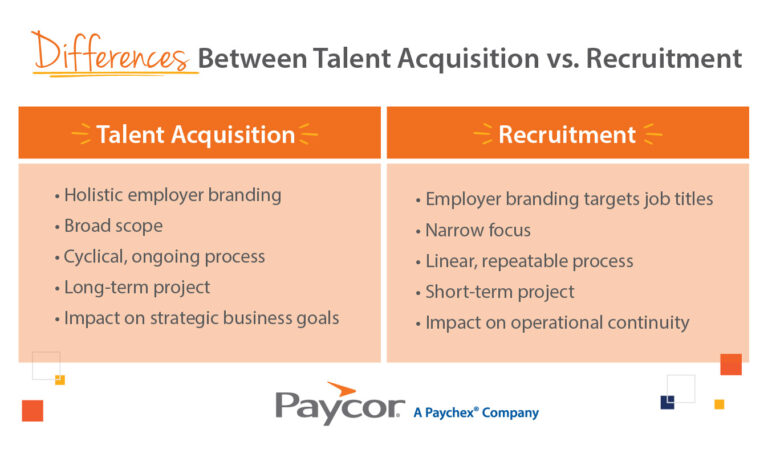
While talent acquisition and recruitment share a goal, there are some key differences. Here’s how they compare:
Branding
Talent acquisition treats employer branding as a core strategy. HR invests time and energy in improving the company’s reputation. The team creates content showcasing company culture, shares employee success stories, and maintains an active presence on professional networks. Employer brand development happens year-round, independent of open positions.
Recruitment showcases the employer brand within one-off job postings. Recruiters may highlight company benefits and culture to attract applicants for specific openings. The branding effort is limited to active hiring campaigns and focuses on selling candidates on individual roles rather than building long-term brand recognition.
Scope
Talent acquisition is broad. HR considers the entire organization’s long-term needs, tracking workforce trends across departments and planning for growth. Leaders identify emerging skill requirements, anticipate gaps, and cultivate diverse talent pools that support multiple business objectives. Talent acquisition addresses organizational capacity, not just individual vacancies.
Recruitment is narrow. HR focuses on filling one position at a time. Each job opening gets treated as a separate project with its own posting, screening process, and hiring decision. The scope is limited to immediate staffing needs within specific departments or teams.
Process
Talent acquisition is cyclical. HR continuously sources candidates, nurtures relationships, and works to expand the talent pipeline. The process never stops. Even when positions are filled, leaders maintain contact with promising candidates, attend industry events, and refine employer branding.
Recruitment is linear. HR follows a start-to-finish process: post the job, screen applicants, interview candidates, make an offer, close the position. Once someone accepts, the recruitment process is over. Each hiring effort stands alone with a clear beginning and end.
Timeline
Talent acquisition operates on a long-term timeline. HR plans months or years ahead, slowly nurturing relationships with candidates who might not be ready to move immediately. The investment pays off over time as the talent pipeline matures.
Recruitment operates on a short-term timeline. HR needs to fill positions within weeks. The urgency drives fast decision-making and quick turnarounds. Every day a position stays open costs money and productivity.
Impact
Talent acquisition impacts long-term business goals. HR aligns hiring with company growth plans, competitive positioning, and long-term workforce needs. An effective strategy should support succession planning and reduce hiring costs over time.
Recruitment impacts operational continuity. HR ensures every department is fully staffed and productive. The work reduces business disruptions, maintains service levels, and addresses immediate staffing crises. Recruitment solves today’s problems so operations can continue smoothly.
The Difference in Talent Acquisition vs. Recruiting Roles
Talent acquisition and recruitment use distinct skills. While both focus on bringing people into the organization, these HR roles operate at different strategic levels.
The Role of Talent Acquisition Employees
Talent acquisition professionals work at a strategic level. They partner with business leaders to forecast workforce needs, identify skills gaps, and develop long-term hiring strategies. These employees think months or years ahead, building relationships and pipelines that support growth.
Talent Acquisition Specialist
A talent acquisition specialist builds and manages candidate pipelines for specific skill sets or departments. The role requires deep knowledge of labor markets, including competitive trends and changing employee expectations. Common responsibilities include:
- Sourcing passive candidates through networking and research
- Attending industry events and career fairs
- Creating employer brand content for social media and job boards
- Conducting initial candidate screenings
- Analyzing recruiting metrics and pipeline health
- Building relationships with candidates who aren’t actively job searching
Talent Acquisition Manager
A talent acquisition manager oversees a company’s entire talent acquisition strategy. They’re responsible for translating business goals into actionable hiring workflows, implementing those plans, and adjusting tactics as needed. Managers lead specialist teams and ensure every hiring initiative aligns with long-term workforce needs. Their primary responsibilities include:
- Developing employer branding strategies
- Establishing recruiting metrics and key performance indicators (KPIs)
- Managing talent acquisition budgets
- Evaluating sourcing channels and vendor partnerships
- Reporting on pipeline health to leadership
- Translating business strategy into actionable hiring plans
The Role of Recruiters
Recruiters execute the hiring process for open positions. The role requires strong organizational and communication skills, as well as the ability to manage multiple searches simultaneously. Recruiters coordinate logistics with both candidates and hiring managers to keep everyone on track. Typical duties include:
- Writing and posting job descriptions
- Screening resumes and applications
- Scheduling and coordinating interviews
- Conducting reference and background checks
- Negotiating offers with candidates
- Ensuring compliance with employment laws
Talent Acquisition vs Recruiting: When Should You Use Each?
Most organizations need both talent acquisition and recruitment. The right choice depends on your timeline, business priorities, and workforce needs.
Use talent acquisition for long-term growth. Deploy this approach when you’re expanding into new markets, building specialized teams, or filling leadership roles. Talent acquisition works best when you have the resources to build long-term relationships and invest in employer branding. Organizations with chronic turnover should prioritize talent acquisition to maintain steady pipelines.
Use recruitment to fill positions fast. This approach is essential when someone quits unexpectedly, projects launch ahead of schedule, or seasonal demand spikes. Recruitment works for high-volume hiring, entry-level positions, and roles with large candidate pools.
Smart HR teams use both simultaneously. Talent acquisition builds the foundation while recruitment handles urgent needs. A tech company, for example, might court senior engineers over months while quickly filling support roles. The combination reduces hiring costs, improves candidate quality, and keeps your company fully staffed at all times.
How Paycor Helps with Talent Acquisition and Recruiting
Paycor is an HCM software that supports both strategic talent acquisition and tactical recruitment. Our comprehensive suite of HR software empowers leaders to streamline hiring, reduce costs, and improve candidate quality.
Paycor Recruiting gives HR the tools to build pipelines, track candidates, and fill positions efficiently. Leaders can post jobs to multiple boards simultaneously, track applicants through each stage, and collaborate with hiring managers in real time. The system automates routine tasks like interview scheduling and candidate communication, freeing your team to build real relationships with top talent.
Recruit and Acquire Talent with Paycor
With the right software, you can improve both recruitment and talent acquisition. Paycor’s integrated platform gives HR teams the tools they need to fill urgent gaps while building sustainable talent pipelines.
It’s time to improve your hiring process. Schedule a guided tour to see Paycor in action.
Talent Acquisition vs. Recruitment FAQs
Read the answers to common questions about talent acquisition and recruitment.
Which is more important: talent acquisition or recruitment?
Both are important, but they serve different purposes. Recruitment solves immediate staffing needs and keeps operations running. Talent acquisition builds the foundation for long-term organizational growth. Companies can’t choose one over the other; instead, leaders should choose the right approach for each situation.
Do recruitment and talent acquisition teams work together?
Yes. In most organizations, these functions overlap or operate within the same HR team. Recruiters may pull candidates from pipelines that talent acquisition specialists built. Talent acquisition managers often oversee both strategic pipeline development and tactical recruitment activities. This collaboration ensures short-term hiring needs get met while long-term workforce planning continues.
Are talent acquisition and recruitment part of HR?
Yes, both functions fall under the HR umbrella. HR owns workforce planning, employer branding, candidate sourcing, and hiring execution. Some larger organizations create dedicated talent acquisition teams that operate within a larger HR department.
Is talent acquisition better for business than recruitment?
Neither approach is better. They address different business needs. Talent acquisition supports long-term strategic goals, like succession planning, while recruitment addresses immediate operational needs, like replacing departing employees or staffing new locations.
Is talent acquisition the same as recruitment?
No. Talent acquisition is a long-term process, while recruitment is a short-term workflow with a clear beginning and end. Talent acquisition builds relationships months or years before positions open. Recruitment fills specific positions as they become available. The approaches use different timelines, processes, and success metrics.
What is the difference between an HR recruiter and a talent acquisition specialist?
HR recruiters focus on filling open positions quickly. They post jobs, screen candidates, and manage the hiring process from application to offer. Talent acquisition specialists build long-term candidate pipelines. They research labor markets, attend networking events, and nurture relationships with passive candidates who might be interested in future opportunities.
What’s the difference between talent acquisition, recruitment, and talent management?
Talent acquisition and recruitment both focus on bringing new people into the organization, but they operate on different timelines. Talent acquisition is strategic and builds long-term pipelines, while recruitment is tactical and fills immediate openings. Talent management is a separate function that focuses on developing and retaining existing employees through performance reviews, career development, training programs, and succession planning. All three functions work together to build and maintain a strong workforce.