








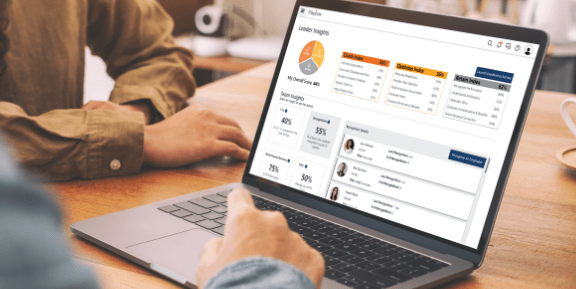

AI in HR has moved from a buzzword to a budget line. HR teams are drowning in manual work, and the tools to take that work off their plate are now built into the platforms they already run. The real question for a business leader isn’t whether AI belongs in HR, but where it creates the most value. This guide walks through what AI in HR really means, the benefits that matter to decision-makers, and eight concrete use cases across the employee lifecycle.
What Is AI in HR?
AI in HR is the use of machine learning, automation, and predictive tools within core HR functions like recruiting, onboarding, performance, and payroll. It isn’t a distant technology concept. It’s software that reads patterns in your workforce data and helps your team act on them, embedded in the systems you use every day.
The difference between AI and basic software automation comes down to learning. Simple automation follows fixed rules: if this happens, then do that. AI goes further by learning from employee data, surfacing insights a person would likely miss, and supporting decisions rather than just executing steps. A rules-based system sends a reminder; an AI-driven system predicts which new hire is at risk of leaving and tells you why.
AI adoption has accelerated fast. SHRM found that AI adoption in HR jumped from 26% to 43% in a single year, a 17-point leap that tells business buyers the market is moving quickly. When nearly half of HR teams are already using AI, evaluating AI-enabled HR platforms stops being optional and starts being a competitive question.
Key Benefits of Using AI in HR
The case for AI in HR rests on four concrete benefits that leaders can measure.
- It frees your team from manual, repetitive work. When AI handles data entry, scheduling, and routine questions, HR gets time back for higher-value work like employee engagement and workforce planning, the strategic work that moves the business forward.
- It turns workforce data into decisions. AI surfaces patterns across thousands of data points that no one could spot manually, which is the foundation of real data-driven decision-making in HR. A manager sees one team’s numbers; AI sees the trend across every team and flags the one that needs attention.
- It improves the employee experience. AI enables faster, more personalized responses across benefits, onboarding, and career development, so employees get answers in seconds instead of waiting days for an HR reply.
- It scales. Using AI helps HR operations grow without adding headcount and cost at the same rate, so a team can support more employees without stretching thinner. That scalability is why AI has real boardroom attention: 91% of global executives report scaling up their AI efforts (Globalization Partners).
8 AI in HR Examples and Use Cases
Here’s where AI creates measurable operational value. The eight use cases below span the full employee lifecycle, from recruiting through offboarding, which shows the breadth of impact available with an AI-enabled HCM platform like Paycor. Read each one through the lens of the problem it solves and the cost it removes. Paycor’s AI teammate, WISE (Workforce Intelligence, Strengthened by Expertise), runs across many of these use cases, monitoring for issues, guiding your team, and taking action inside the tools you already use.
1. Recruiting and Talent Acquisition
AI takes the grind out of hiring. It can draft job descriptions, screen resumes against role requirements, and schedule interviews automatically, which cuts time-to-hire and lifts a heavy load off recruiters. Matching tools go a step further, surfacing the most qualified candidates from a large applicant pool so leaders fill roles faster without lowering the bar. Our guide to AI recruiting covers the workflow in depth.
There’s a fairness angle worth weighing, too. Well-designed AI can reduce bias in early screening by evaluating candidates against consistent, job-related criteria rather than gut feel. That said, the tool is only as fair as its design, so bias safeguards belong on your evaluation checklist, a point we’ll return to below.
2. Onboarding New Employees
A strong first week pays off for months. AI automates onboarding workflows, from paperwork to provisioning to training assignments, so new hires reach productivity faster and nothing falls through the cracks. Pairing AI with workflow automation means each step triggers the next without a coordinator chasing it down. Paycor WISE takes the process a step further as an agentic AI teammate that can complete onboarding steps end to end, not just remind someone that a task is due.
Self-service is the other half. AI-driven portals let new employees get answers to common questions on their own, which improves the experience for the new hire and frees HR from repetitive first-week requests. A consistent, well-run onboarding process also reduces early attrition, and since replacing a new hire who leaves in the first 90 days is expensive, that’s a number decision-makers can tie straight to cost savings.
3. Employee Self-Service and HR Help Desk Automation
Most HR tickets are the same handful of questions asked over and over. AI chatbots and virtual assistants handle that high volume, answering benefits questions, checking PTO balances, and looking up policies without pulling in HR staff. Modernizing the help desk this way lowers ticket volume, speeds up resolution, and lifts employee satisfaction scores.
The bigger win is availability. AI-powered self-service gives employees around-the-clock access to HR information, so a night-shift worker or a remote employee in another time zone gets a real answer at 9 p.m. without waiting for the office to open. Less friction for employees, less dependency on the HR team. Paycor WISE fits here, too: it delivers help in chat, email, and voice, and because it’s built to act rather than only answer, it can carry the request to done instead of handing the employee a link.
4. Performance Management
AI makes reviews fairer and less painful. It automates the data collection behind performance reviews and surfaces objective signals, like goal completion and project delivery, rather than leaning only on a manager’s memory of the last few weeks. The result is a review grounded in evidence instead of impression.
It also acts as an early-warning system. AI can flag an employee showing signs of disengagement or slipping performance before the problem escalates, which gives a manager time to step in while a conversation can still change the outcome. Consistent, data-informed performance cycles connect directly to retention and productivity, so it pays off as a business advantage, not just an HR nicety.
5. Learning and Development
One-size-fits-all training wastes time and money. AI delivers personalized learning recommendations based on each employee’s role, performance data, and career goals, so people spend their development hours on skills that matter to them and to the business. A sales rep and an engineer no longer get the same generic course library.
For leaders, the payoff is closing skill gaps at scale. AI-driven L&D tools let you build capability across the workforce without a matching jump in program spend, since the system does the matching and sequencing that a small L&D team never could by hand. Continuous, personalized development also links to stronger retention, a direct benefit for anyone focused on lowering turnover costs.
6. Workforce Planning and Predictive Analytics
Workforce planning is where AI earns a seat at the executive table. By analyzing historical workforce data, AI predicts future staffing needs, so leaders can plan hiring, promotions, and restructuring with more confidence and less guesswork. Predictive analytics also spots skill gaps before they turn into an emergency, which supports a forward-looking talent strategy instead of scrambling to backfill.
Scenario modeling takes it further. Workforce planning AI can forecast how a headcount change would affect productivity or cost, giving executives a way to test a decision before they make it. Modeling the impact of adding ten people to one team, or trimming another, turns a gut call into an informed one.
7. Payroll and Benefits Administration
Payroll errors are costly and often public. AI reduces those errors and the compliance and brand risk behind them by validating data automatically, flagging anomalies before a run, and keeping calculations aligned with changing tax rules across jurisdictions. Fewer mistakes mean fewer corrections, penalties, and frustrated employees.
Benefits get simpler, too. AI guides employees through enrollment and life events with options personalized to their situation and eligibility, so a new parent or a relocating employee sees the choices that apply to them. Automating this transactional work frees HR leaders to focus on strategy instead of paperwork. Payroll is a natural home for Paycor WISE, which monitors for issues like employees approaching overtime thresholds and tracks regulatory changes across states, with expert compliance knowledge built into every action.
8. Offboarding
The employee exit deserves as much rigor as the entrance. AI standardizes and automates offboarding checklists, including equipment retrieval, system access revocation, and exit survey delivery, so nothing gets missed and no former employee keeps access they shouldn’t have. Consistency here is a security and compliance benefit as much as a convenience.
The exit data is a goldmine. AI can analyze exit interview responses across many departures and surface patterns in voluntary turnover, turning a stack of individual conversations into intelligence a leader can act on. When the same reason shows up again and again, you’ve found a retention problem worth fixing.
Types of AI Used in HR Technology
Knowing the AI building blocks helps you evaluate platforms with confidence. Five types show up most often.
- Machine learning finds patterns in data and improves as it sees more, which powers predictions like turnover risk.
- Generative AI creates content, drafting job descriptions, review summaries, or policy answers.
- Natural language processing (NLP) lets software understand and respond to plain-language questions, which is what makes an HR chatbot work.
- Predictive analytics uses historical data to forecast what’s likely to happen next, from staffing needs to flight risk.
- Agentic AI goes a step beyond the others. Instead of just surfacing an answer, it can reason through a task, orchestrate the steps, and carry the work to completion. Paycor WISE is an example: an AI teammate that monitors, guides, and acts inside the tools your team already uses.
Robotic process automation (RPA) is worth separating out. RPA follows fixed rules to handle repetitive digital tasks, like moving data between systems, and it doesn’t learn the way the other AI types do. It’s best for high-volume, predictable steps, while machine learning and predictive analytics handle the judgment-heavy work. Modern HCM platforms like Paycor combine several of these AI types into one experience, so you get the full range without stitching together separate point tools.
Challenges and Considerations When Adopting AI in HR
AI in HR comes with real responsibilities and treating them seriously is part of doing it well.
Data privacy sits at the top. HR data is sensitive, so employee data protection must be a primary concern when you evaluate any AI-powered platform. Ask vendors where data is stored, how it’s secured, who can access it, and whether it’s used to train models outside your organization.
Algorithmic bias is the next watch item. AI in recruiting and performance tools can pick up and repeat bias in the data it learns from, so look for responsible-AI safeguards: bias testing, human review of high-stakes decisions, and transparency about how the model works.
Change management matters as much as the technology. Employee trust makes or breaks AI adoption, so HR leaders should communicate early and openly about what AI does, what it doesn’t do, and how it supports people rather than replacing judgment. A clear internal policy helps, and our AI policy template gives you a starting point.
Finally, weigh compliance. AI regulation is expanding at the federal and state level, so a platform’s ability to keep pace with new rules is a risk factor worth building into vendor selection.
How to Evaluate AI-Powered HR Software
When you assess AI features in an HR platform, a few questions separate substance from marketing. Ask about data security practices and where your information lives. Ask about explainability: can the vendor tell you why the AI reached a given recommendation? Ask about integration, since AI works best with clean data flowing across your systems. And ask about accountability: who’s responsible when the AI gets something wrong?
One distinction matters more than the rest. Some platforms embed AI across the full HCM suite, so it draws on payroll, talent, and workforce data together, while others bolt AI features onto legacy systems where the data stays siloed. Embedded AI sees the whole picture; bolted-on AI sees a corner of it. Paycor’s approach builds AI into payroll, talent, and workforce management as one system, which is what connects the use cases above into a single, coherent experience rather than a set of disconnected features.
How Paycor Supports HR Teams with AI
Paycor embeds AI across its HCM platform to help HR teams cut administrative work, surface workforce insights, and make better decisions at every stage of the employee lifecycle. Because the intelligence lives inside the same system that runs your payroll, talent, and workforce management, a signal in one area connects to the data that explains it, from a hiring bottleneck to a retention risk.
These capabilities come together in Paycor WISE, an expert-backed AI teammate that monitors, guides, and acts on your behalf inside the tools you already use. Most AI tools stop at answering questions; WISE is built to get the work done, from flagging a compliance issue to completing an onboarding workflow. And you can rest assured that there’s always a human in the loop with WISE. As the admin, you are the ultimate decision maker.
Paycor builds these tools for the reality of mid-market leaders who need real capability without enterprise-level complexity or cost. You get AI that does meaningful work across recruiting, onboarding, performance, and payroll, in a platform your team can really run. Ready to see it in action? Take a tour and explore Paycor’s AI-powered HR and payroll solutions and see how much manual work your team can hand off.