










Unlike most nations, the US labor law heavily favors employers. Employment is generally ‘at will’, and can therefore be terminated at any time. There is usually no burden on employers to prove “just cause”—they simply have to avoid discriminatory or illegal action. However, many states do apply important exemptions.
What Does At-Will Employment Mean?
Employment at-will is the principle that an employer can terminate employment for any reason, at any time provided that is not illegal. Likewise, an employee is free to leave a job at any time for any or no reason with no adverse legal consequences. All states have some form of employment at-will although mostly with some restrictions—notably Montana, in line with European nations, only allows this during an initial 12-month probation period.
At-Will Employment Laws by State
To visualize these differences, we’ve created a map detailing at-will employment states and states with related laws across the US.
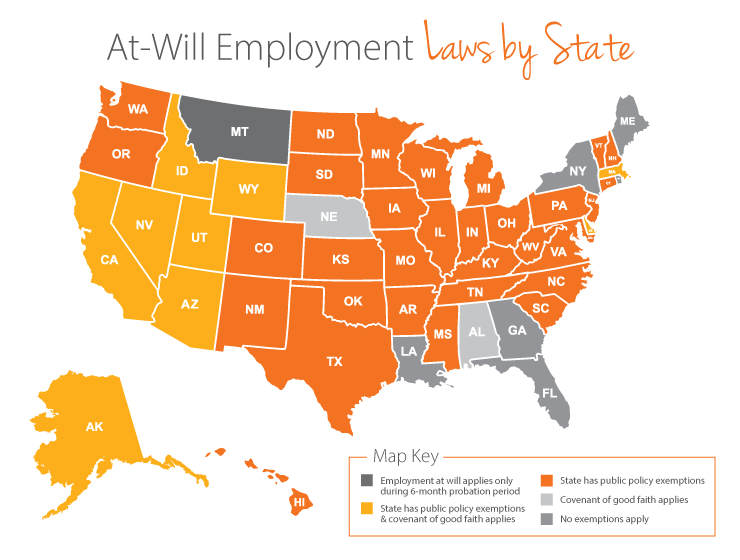
Here is the list of at-will employment states combined with states that allow public policy exceptions, covenants of good faith and implied employment contract exceptions broken down in a helpful table.
| State | Public Policy Exemption | Covenant of Good Faith | Implied Contract Exception |
|---|---|---|---|
| Alabama | No | Yes | Yes |
| Alaska | Yes | Yes | Yes |
| Arizona | Yes | Yes | Yes |
| Arkansas | Yes | Yes | Yes |
| California | Yes | Yes | Yes |
| Colorado | Yes | Yes | Yes |
| Connecticut | Yes | Yes | Yes |
| Delaware | Yes | Yes | No |
| Florida | No | No | No |
| Georgia | No | No | No |
| Hawaii | Yes | Yes | Yes |
| Idaho | Yes | Yes | Yes |
| Illinois | Yes | Yes | Yes |
| Indiana | Yes | Yes | No |
| Iowa | Yes | Yes | Yes |
| Kansas | Yes | Yes | Yes |
| Kentucky | Yes | Yes | Yes |
| Louisiana | No | No | No |
| Maine | No | No | Yes |
| Maryland | Yes | Yes | Yes |
| Massachusetts | Yes | Yes | No |
| Michigan | Yes | Yes | Yes |
| Minnesota | Yes | Yes | Yes |
| Mississippi | Yes | Yes | Yes |
| Missouri | Yes | Yes | No |
| Montana* | Yes | Yes | No |
| Nebraska | No | Yes | Yes |
| Nevada | Yes | Yes | Yes |
| New Hampshire | Yes | Yes | Yes |
| New Jersey | Yes | Yes | Yes |
| New Mexico | Yes | Yes | Yes |
| New York | No | No | Yes |
| North Carolina | Yes | Yes | No |
| North Dakota | Yes | Yes | Yes |
| Ohio | Yes | Yes | Yes |
| Oklahoma | Yes | Yes | Yes |
| Oregon | Yes | Yes | Yes |
| Pennsylvania | Yes | Yes | No |
| Rhode Island | No | No | No |
| South Carolina | Yes | Yes | Yes |
| South Dakota | Yes | Yes | Yes |
| Tennessee | Yes | Yes | Yes |
| Texas | Yes | Yes | No |
| Utah | Yes | Yes | Yes |
| Vermont | Yes | Yes | Yes |
| Virginia | Yes | Yes | No |
| Washington | Yes | Yes | Yes |
| West Virginia | Yes | Yes | Yes |
| Wisconsin | Yes | Yes | Yes |
| Wyoming | Yes | Yes | Yes |
* Employment at will only applies during 6-month probation period.
Now let’s explain what that means for businesses…
What States Are Not At-will Employment States?
Montana is the only state that is not an at-will employment state. In Montana, employers must have a valid reason for terminating an employee, and employees can only be fired for just cause.
For all other states, employers and employees alike can terminate employment for any reason, at any time, without advance notice, provided the reason is not illegal.
Note: it’s important to understand that nearly all at-will states have exceptions or exemptions that limit an employer’s right to fire at will. So even though most states are at-will employment, the specific circumstances under which at-will employment applies can differ based on your location and employment situation.
Are There Any Exceptions to At-Will Employment?
Yes. There are exemptions and exceptions. Here are the exemptions to employment at-will:
Public Policy Exemption
The majority of states apply some form of public policy exemption, preventing the termination of an employment relationship if this would violate public policy. This means that an employee can’t be fired for refusing to do something that would go against state law, for reporting a violation of the law or when an employee has acted in the greater good of the public, like performing jury duty.
Covenant of Good Faith
Many states also maintain a further exception: requiring employers act in good faith. For instance, the termination of an employee’s employment relationship immediately before they were due to receive a large commission could be interpreted as being in bad faith. Similarly, an employer cannot give false reasons for an employee’s termination.
This covenant could also be violated in a case where an employee was terminated after a long time where they had been given positive performance reviews and led to believe that their job was secure—in order to prove that the termination had not be conducted in bad faith, employer’s might be expected to show “just cause”.
Implied Contract Exemption
A further common exemption is for cases when a contract, employee handbook or other employer behavior implies that an employee will only be terminated for “just cause”—even when employees have signed contracts stating that their employment is at-will. Formal collective bargaining agreements are generally negotiated with high-level employees.
Additional Statutory Exceptions
While the exemptions listed above apply only in certain states, there are other circumstances in which employment at will doesn’t apply:
- Public Sector Employees: Typically, public-sector employees are not subject to at-will employment.
- Unionized Jobs: When employment contracts are the subject of union bargaining, a common demand is that employees can only be terminated for “just cause”.
- Contract Workers: If employees have an employment contract that lists a specific start and end date, there will likely be stipulations on the exact circumstances in which the contract can be terminated.
- Discrimination: Civil rights legislation protects employees from termination in the case of discrimination on the basis of race, gender, religion, national origin, sex, genetic information or age.
- Protected Employment: Employment cannot be terminated when an employee is on job protected leave, such as that under the Family and Medical Leave Act legislation.
- Whistleblowing: State and federal laws protect whistleblowers against retaliation and wrongful termination.
What are the Advantages of Employment At-Will?
In theory, at-will employment offers freedom and flexibility to both employers and employees. It gives employers the financial security to reduce labor costs fast. It also means that employees can choose to leave a job they dislike without having to work any notice period. However, critics claim that at-will employment leads to job insecurity, disadvantaging workers.
Can Terminated At-Will Employees Collect Unemployment?
State law determines who is eligible for unemployment benefits, how much each individual will receive and for how long they will receive it. And, every case is unique. However, many states often allow at-will employees who have been terminated through no fault of their own to qualify for unemployment benefits. Employers who do terminate at-will employees should keep in mind that unemployment claims could trigger an increase in unemployment insurance taxes.
Use Paycor to Stay Compliant with Employment Law
Keeping up with ever-changing HR laws can sometimes feel overwhelming; that’s why Paycor partners with HR leaders to help keep their businesses compliant. Paycor HR software features alerts, recommendations, reminders and updated resources you can count on. Looking for a payroll partner that does more? Discover how Paycor Compliance Solutions can help you.
Paycor is not a legal, tax, benefit, accounting or investment advisor. All communication from Paycor should be confirmed by your company’s legal, tax, benefit, accounting or investment advisor before making any decisions.

At-Will State FAQs
Still have questions about state at-will employment? Read on!
Are all states at-will states?
No, not all states are an at-will employment states. Montana is the sole exception because the State requires Montana employers to have “good cause” for terminating employees after a probationary period.
How many states are at-will employment?
There are 49 at-will employment states in the U.S. While at-will employment is the default standard across these states, many have established their own exceptions and protections through public policy, implied contracts, or good faith provisions.