









Today’s hiring process does more than fill open roles. It helps organizations attract stronger candidates, reduce time-to-fill, improve compliance, and enhance the employee experience from day one.
Yet many employers still struggle with outdated workflows or inconsistent interview practices. Having a well-defined, step-by-step process for hiring employees can transform your HR team’s talent acquisition and recruiting outcomes and improve long-term talent retention.
Below, we break down the five steps of the hiring process, explore how the hiring system works, and share actionable strategies for building a scalable, compliant approach that works for organizations of all sizes.
What is the Hiring Process?
The hiring process is a structured series of steps employers use to attract, assess, select, and onboard new employees for a job opening. While each company’s process may differ, the purpose remains the same: to find the best-qualified candidate in the most efficient way possible.
Importance of Having an Effective Hiring Process
A strong hiring process is important because it:
- Creates consistency across hiring teams
- Reinforces compliance with labor regulations and state-specific hiring laws
- Helps ensure every candidate receives a fair experience
- Reduces hiring bias
- Helps organizations compete in a tight labor market
- Builds alignment among HR, recruiters, and department leaders
- Improves the overall quality of hire
Note: Companies that invest in a structured hiring process are better equipped to meet evolving workforce needs and attract top talent, even in competitive markets. U.S. employers filling $60,000 salary roles save between $7,800 and $22,500 by reducing mis-hires through skills-based hiring (TestGorilla).
How Does the Hiring Process Work?
At a high level, the employee hiring process works by guiding both candidates and internal teams through a predictable series of stages. Each stage builds on the next to help employers evaluate candidates accurately and make decisions confidently.
Most steps of the hiring process involve the HR team and follow this general sequence:
- Identify talent needs: Confirm the role, the business case, and the required skills.
- Source candidates: Promote roles across job boards, social media, referrals, and talent networks.
- Evaluate applicants: Screens, assessments, structured interviews, and background checks.
- Select and offer: Align stakeholders, make the decision, and extend the offer.
- Onboard new hires: Create a smooth transition into the organization.
5 Stages of the Hiring Process
Below are the five stages of the recruitment and hiring process, along with best practices to strengthen each one to ensure better hiring outcomes.
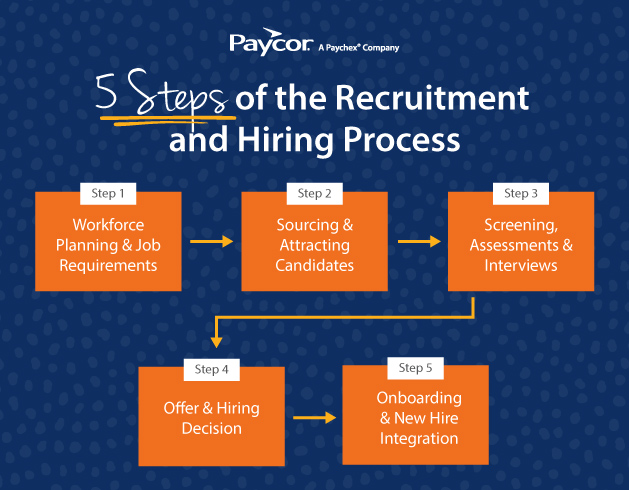
1. Workforce Planning & Job Requirements
A successful HR hiring process begins long before the job is posted. Workforce planning helps ensure the organization has full clarity into why a role is needed and what success looks like.
This stage usually includes:
- Job analysis: Identifying duties, responsibilities, and required competencies.
- Alignment conversations: Meeting with department leaders to confirm priorities, timelines, and success criteria.
- Compensation benchmarking: Making sure salary ranges are competitive in your market.
- Compliance review: Confirming hiring practices align with relevant laws such as ban-the-box regulations or EEOC guidance.
- Crafting detailed job descriptions: Clearly describing the role’s purpose, responsibilities, qualifications, and work environment.
2. Sourcing & Attracting Candidates
Once the role is defined, it’s time for HR to build a strong talent pipeline. The sourcing phase determines who will see your job and, ultimately, who will apply.
Effective sourcing strategies include:
- Job postings on major job boards (Indeed, ZipRecruiter) to generate broad visibility.
- Posting on niche job boards for specialized roles.
- Employee referral programs, which often deliver high-quality candidates at lower cost.
- Social recruiting, using platforms such as LinkedIn, Facebook, and Instagram.
- Employer branding through career pages, videos, and culture-focused content.
- AI-powered sourcing tools that search wider networks and match candidates based on skills.
- Staffing agencies for temporary, seasonal, or hard-to-fill positions.
Note: Because job openings still remain high across many industries (BLS), proactive sourcing is more important than ever. Companies that invest in sourcing tools and automation consistently outperform those relying solely on job boards.
3. Screening, Assessments & Interviews
This stage determines which candidates move forward in the hiring process, so structure and consistency are essential for fairness and accuracy. This stage is also often where hiring delays occur, so automation and streamlined tools can significantly reduce bottlenecks.
Key components include:
- Resume and application screening: Automated tools and AI can speed up this step dramatically.
- Phone screens: Used to evaluate availability, experience, communication skills, and role fit.
- Skills assessments: Practical tests, simulations, or cognitive assessments help employers validate skills objectively.
- Behavioral and structured interviews: Asking the same questions to each candidate reduces bias and helps ensure a fair evaluation process.
- Background checks: Employment verification, criminal history, education verification, and more.
- Pre-employment screenings: Drug testing or medical screenings where legally allowed.
4. Offer & Hiring Decision
Once interviews are complete, hiring teams use the information gathered in the previous stage and collaborate to select the best-fit candidate.
This stage of hiring includes:
- Decision-making meetings with hiring managers and interviewers.
- Reference checks when needed.
- Compensation and offer approval workflows.
- Preparing and sending the offer letter.
- Communicating with finalists and other applicants.
Note: Employers should provide clear timelines, transparent expectations, and prompt communication to maintain trust with candidates especially in a competitive labor market.
U.S. staffing firms say they hire more than 14 million temporary and contract workers annually, demonstrating how important flexibility and speed are in the decision-making stage (American Staffing Association).
5. Onboarding & New Hire Integration
It’s important to keep in mind that the process of hiring employees doesn’t end when a candidate signs the offer, though. Onboarding is where employee retention truly begins so it’s an equally important component of hiring.
A comprehensive onboarding experience should include:
- Digital onboarding workflows with e-sign documents, tax forms, and direct deposit setup.
- New hire orientation covering company values, mission, and culture.
- Role-specific training plans for the first 30, 60, and 90 days.
- Technology provisioning, including hardware and software access.
- Mentorship or buddy programs to help new hires acclimate.
- Check-ins with managers to promote early success and engagement.
Additional Tips to Improve the Employee Hiring Process and Procedure
Even with a well-defined employee hiring process in place, there’s always room to refine workflows, strengthen candidate engagement, and improve overall efficiency.
Here are a few additional tips:
Use AI and Automation to Streamline Hiring
Artificial intelligence can automate repetitive tasks like screening, scheduling, and matching candidates to job descriptions. This not only speeds up hiring but also helps reduce unconscious bias while providing deeper insights into candidate potential.
Create a Consistent Interview Framework
Use scorecards, standardized questions, and evaluation rubrics to assess every candidate fairly. Standardization improves hiring accuracy and reduces the risks associated with unstructured interviews.
Improve Communication and Transparency
Candidates frequently drop out of poorly communicated company hiring processes. Set clear expectations about next steps, provide updates after each stage, and make sure managers follow a consistent communication cadence.
Monitor Key Recruiting Metrics
Tracking recruiting metrics such as time-to-hire, candidate satisfaction, cost-per-hire, pipeline conversion rates, and offer acceptance rates provides insight into where your process needs refinement. High-performing companies analyze these metrics regularly.
How Paycor Helps You with the Hiring Process
Paycor provides an end-to-end talent acquisition suite that connects every step of the hiring process:
- Recruiting Software: Automates job postings, applicant tracking, communication, and interview scheduling.
- Talent Acquisition Solutions: Centralizes all recruitment tasks into one intuitive platform.
- Smart Sourcing: Uses AI to expand candidate reach and identify top matches automatically.
- Onboarding Software: Streamlines digital documents, workflows, and task tracking.
- HR Software: Provides a centralized hub for employee data and lifecycle management.
With Paycor, organizations can modernize hiring from start to finish, creating a seamless, compliant, and candidate-friendly experience.
Additional Resources to Help with Your Hiring Process
Building a structured, compliant, and efficient hiring process takes more than just the right software, it also requires tools, templates, and expert guidance. To help HR leaders streamline recruiting and make smarter hiring decisions, we’ve gathered Paycor’s most popular resources on hiring strategy, compliance, and candidate evaluation.
Each of the following guides and templates offers actionable insights or practical tools to strengthen every stage of your hiring process:
- Leader’s Guide to Hiring & Recruiting: Learn proven strategies to attract, interview, and retain top talent while aligning hiring goals with your organization’s overall strategy.
- HR Compliance Checklist: Stay compliant with federal and state employment laws throughout the hiring process.
- Recruiting & Hiring Toolkit: Get ready-to-use templates, worksheets, and checklists to simplify day-to-day recruiting tasks.
- How AI Technology Transforms Recruiting and Hiring: Discover how HR teams are using AI to improve candidate sourcing, reduce bias, and speed up decision-making.
- Interview Scorecard Template: Standardize interviews, improve candidate comparisons, and help ensure fair, data-driven evaluations.
- Tips to Create a Killer Job Description: Write compelling, inclusive job descriptions that attract the right candidates from the start.
- HR Guide to Internal Recruiting: Learn how to identify and promote top performers from within your organization.
- Hiring Manager Intake Form: Use this form to align recruiters and hiring managers early, clarify job requirements, and speed up candidate selection.
Develop Your Recruitment and Hiring Process with Paycor
Ready to build a more organized, efficient, and candidate-friendly hiring process? Paycor’s recruiting, onboarding, and HR & Payroll solutions help employers modernize their end-to-end hiring workflow saving time, supporting compliance, and helping your teams make the right hiring decisions every time.
Take a tour today!
Hiring Process FAQs
Still have questions about effective hiring processes? Read one!
What are the 5 stages of the hiring process?
The five stages of the hiring process are workforce planning, sourcing, screening, selection and offer, and onboarding.
What are the 7 steps of the recruitment process?
A deeper recruitment model includes planning, sourcing, screening, interviewing, assessments, selection, and hiring.
What are some challenges with the hiring process?
Employers commonly struggle with skill shortages, long decision cycles, outdated technology, limited applicant pipelines, and inconsistent interview practices.
How long is the typical hiring process?
Hiring timelines typically range from 24–44 days depending on job complexity, industry, candidate availability, and internal approval workflows (Workable).
How is AI transforming the hiring process?
AI enhances speed and accuracy by automating routine tasks, improving sourcing, reducing manual screening, supporting bias reduction, and helping teams prioritize top candidates quickly.