









HR departments don’t fall behind because people aren’t working hard enough. They fall behind because too much of that work is manual. Time cards entered by hand. Benefits eligibility checked in spreadsheets. Onboarding documents emailed back and forth. Each task takes minutes. Cumulatively, that time could go toward workforce planning, manager development, or employee experience improvements that move the needle. HR technology exists to reclaim that time.
What Is an HR Tech Stack?
An HR tech stack is the suite of software applications an organization uses to manage its human resources functions. The term “stack” signals that these tools are meant to work together — layered, connected, and covering the full employee lifecycle from first application to final paycheck.
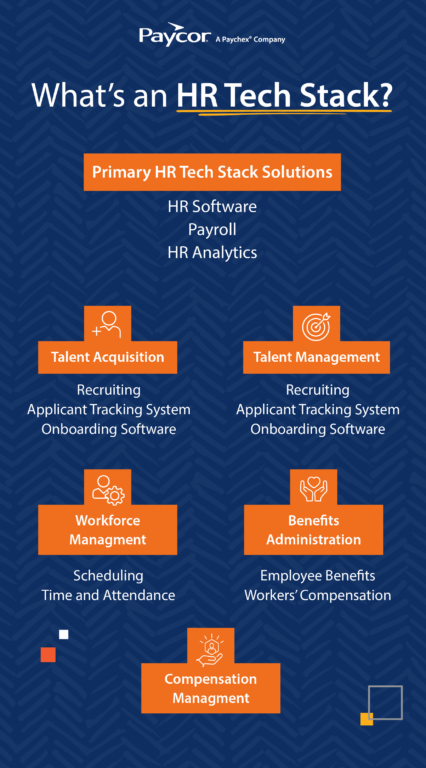
A mature stack typically spans six broad categories: core HR administration, talent acquisition, talent management, compensation management, workforce management, and benefits administration. Some organizations run these as separate point solutions from different vendors. Others consolidate them under a single HCM platform. Both approaches have tradeoffs, and the right answer depends on company size, industry, and how much IT capacity HR actually has.
The phrase gets used loosely, so it’s worth distinguishing it from two related terms: an HRIS (Human Resource Information System) handles core employee data storage and basic HR functions; an HRMS (Human Resource Management System) adds process management on top of that data. An HR tech stack is broader than either — it’s the full ecosystem of tools, which may or may not include an HRIS or HRMS at its center.
Importance of Having an HR Tech Stack
HR without technology is largely an administrative exercise. With it, HR becomes a function that can contribute to workforce planning, retention strategy, and compliance management at scale.
The business case is not subtle. Workers toggle between apps and websites nearly 1,200 times per day, consuming roughly 9% of their annual work time in context-switching alone. For HR teams managing payroll runs, open enrollment, hiring cycles, and performance reviews simultaneously, that number is almost certainly higher. A coordinated tech stack reduces that drag.
The market reflects how seriously organizations are taking this. The global HR tech industry reached roughly $40.5 billion in 2025, with the HCM segment alone expected to approach $76-81 billion by 2029. More than 80% of organizations planned to increase HR tech spending over the next two years in HR.com’s 2024 State of Today’s HR Tech Stack report. That’s not discretionary spend — it’s investment in the infrastructure HR runs on.
A well-built stack also closes compliance gaps. Automated tracking keeps organizations current with changing labor laws, tax requirements, and reporting obligations across multiple states. For companies operating in jurisdictions with complex wage and hour rules, that automation isn’t a nice-to-have.
HR Tech Stack Components
The diagram below maps the core components of a complete HR tech stack. Each layer serves a distinct function and, ideally, feeds data into adjacent systems rather than holding it in isolation.
[HR Tech Stack Diagram — illustrating layered components from core HR through benefits administration]
Primary HR Tech Stack Solutions
These are the foundational systems every organization needs before adding specialized tools. Think of them as the operating layer the rest of the stack sits on.
HR Software
Core HR software handles employee records, org charts, policy management, and the administrative work that underlies every other HR function. It’s where headcount data lives, where employment changes get recorded, and where compliance documentation is stored. A weak HRIS creates downstream problems across every other layer of the stack.
Payroll
Payroll is the function where HR errors have the most direct financial consequences. Beyond running checks and direct deposits, modern payroll systems handle tax filings, multi-state compliance, garnishments, and year-end reporting. The most common reason organizations switch payroll vendors is reliability — not price, not features. Errors erode employee trust fast.
HR Analytics
Analytics tools pull workforce data from across the stack and surface patterns HR leaders can actually use: turnover trends, time-to-fill by department, overtime exposure, engagement scores by manager. Organizations that treat analytics as an afterthought rather than a stack requirement tend to make workforce decisions based on intuition and anecdote. That’s a competitive disadvantage in tight labor markets.
Talent Acquisition
The tools in this category cover everything between the moment a job opens and the moment an offer is accepted and an employee shows up on day one.
Recruiting
Recruiting software manages job postings, candidate pipelines, interview scheduling, and offer generation. The better platforms consolidate sourcing, screening, and communication in one place rather than forcing recruiters to manage candidates across email, a spreadsheet, and a standalone ATS. Consider that 97% of employers plan to increase recruiting technology investment — the organizations that move fastest tend to win the candidates everyone else is chasing.
Applicant Tracking System
An ATS is the record of truth for open requisitions and candidate movement through the hiring process. It captures application data, tracks EEOC compliance, automates disposition notices, and stores interview feedback. Organizations using an ATS report that 94% of recruiters see a positive impact on the hiring process. The ATS is also where a lot of DEI data originates — structured pipelines create auditable records that unstructured processes don’t.
Onboarding Software
Onboarding software bridges the gap between offer acceptance and productive employment. That gap is expensive. Poor onboarding costs organizations an estimated $1,500 per employee just in administrative time, and new hires who experience a structured onboarding process are 69% more likely to stay three years. Yet onboarding is the capability where HR professionals most often report their technology falls short — about one-third cite a lack of tools as the reason their onboarding underperforms.
Talent Management
Where talent acquisition is about getting people in, talent management is about keeping them growing. These tools span the post-hire experience.
Talent Development
Talent development tools support performance management, goal setting, feedback, and succession planning. The most effective tools connect individual development plans to business outcomes — not just annual review scores. When managers can see skill gaps relative to where the business is headed, development conversations get more specific and more useful.
Career Management
Career management software supports internal mobility by making available roles, skill pathways, and development resources visible to employees. Organizations with active internal mobility programs retain employees nearly twice as long as those without them. The technology is the mechanism — but the culture has to want it.
Learning Management
A learning management system (LMS) delivers, tracks, and manages training content across the workforce. Compliance training, new-hire orientation, skills development, and certifications all live here. The LMS that sits unconnected from performance data and career paths is a content library. The one that feeds into development planning is an actual HR tool.
Compensation Management
Compensation planning tools manage salary structures, merit cycles, bonus modeling, and equity analysis. For mid-sized organizations running compensation out of spreadsheets, the manual process creates both accuracy risks and fairness exposure — pay equity gaps are easier to miss when the data is fragmented. Centralized compensation management surfaces those gaps before they become legal issues.
Workforce Management
These tools handle the operational side of labor: who works when, how long, and what it costs.
Scheduling
Scheduling software builds and communicates work schedules, manages shift swaps, and tracks coverage against demand. For organizations with hourly workers, this is where overtime exposure originates. A scheduling system that doesn’t integrate with time-tracking creates a gap where hours get counted twice or not at all.
Time and Attendance
Time and attendance software captures hours worked, manages leave accruals, and feeds pay data into payroll. When time-tracking and payroll are separate, disconnected systems, the reconciliation work that happens between them falls on someone in HR or finance. Tight integration eliminates most of that manual effort.
Benefits Administration
Benefits administration covers the tools that manage what employees receive beyond base pay.
Employee Benefits
Benefits software manages open enrollment, life event changes, carrier connections, and ACA compliance. The complexity here scales with workforce size and benefits diversity. A platform that automates carrier data feeds and eligibility rules dramatically reduces the administrative burden of open enrollment — particularly for HR teams that run it with small staffs.
Workers’ Compensation
Workers’ compensation tools track workplace incidents, manage claims, and report on injury trends. Organizations that treat workers’ comp as a pure finance function rather than an HR function often miss the safety pattern data that could prevent the next claim. The technology creates a record; what organizations do with it determines whether it adds value.
Essential Features of HR Tech Stacks
Integration
A collection of HR tools that don’t share data isn’t a stack. Integration — via native connections, open APIs, or middleware — is what transforms separate applications into a coordinated system. When payroll pulls hours from time-tracking without manual entry, when recruiting feeds candidate data directly into onboarding, and when performance data informs compensation planning, the stack works as intended. Without integration, HR teams spend meaningful time on data reconciliation that should be automated.
Evaluate integration depth before you evaluate features. A tool with every capability you need but no clean connection to your core HR system will create more work, not less.
User-Friendly Design
HR software that employees and managers won’t actually use provides zero return on its licensing cost. The toggle tax is real: workers already switch applications nearly 1,200 times per day. Every time a manager opens a separate system to approve a request, submit a goal, or look up a policy, you’re asking them to absorb cognitive load that doesn’t serve anyone.
During vendor evaluation, test the interface with the actual people who’ll use it daily — managers and employees, not just HR administrators. The experience HR sees during a demo often looks nothing like what a frontline supervisor encounters.
AI and Automation
About 45% of organizations already use AI in at least one HR function, and the use cases are expanding. AI tools in HR currently cover resume screening, interview scheduling, predictive attrition modeling, compensation benchmarking, and skills gap identification. The ROI on some applications is measurable: AI-powered recruiting tools have been shown to reduce recruitment costs by up to 30%.
The caveat: AI tools require good underlying data. Organizations with fragmented or inconsistently maintained HR data will get inconsistent AI outputs. Garbage in, garbage out applies as much to predictive analytics as it does to any other data product.
Considerations for Building Your HR Tech Stack
Employee Experience
The people most affected by your HR tech stack are the ones who aren’t in the HR department. Every time an employee struggles to find their pay stub, can’t see their available PTO, or has to email HR for something that should be self-serve, you’re eroding experience and generating administrative work simultaneously.
Build the stack with the employee interface in mind, not just the administrator interface. The two are often dramatically different within the same platform, and vendors don’t always volunteer that distinction.
Scalability
The stack that works at 150 employees may not work at 500. Scalability emerged as the top reason organizations switched HR vendors in 2024, cited by 58% of buyers. Before committing to a platform, map out what your workforce will look like in three to five years — in headcount, geography, and workforce composition — and ask vendors directly how their platform handles that growth.
Pricing models matter here too. Per-employee-per-month pricing that looks reasonable at current headcount can become prohibitive quickly. Know what the cost curve looks like before you sign.
Security
HR systems hold some of the most sensitive data in any organization: Social Security numbers, bank account information, performance records, medical leave documentation, and compensation history. A breach of HR data is not just an IT problem — it’s a legal and reputational one.
Evaluate security posture with the same rigor you apply to features. Ask about SOC 2 Type II certification, data encryption standards, access controls, and incident response timelines. Your IT and legal teams should review any platform that will hold employee PII before the contract is signed.
How to Build an HR Tech Stack
Step 1: Audit What You Already Have
Before adding anything, document every HR tool currently in use — including the spreadsheets people built because the official system didn’t do what they needed. Map each tool to the function it serves and identify where data gaps or manual workarounds exist. The audit will surface redundancies (tools doing the same thing) and coverage gaps (functions nobody is supporting well).
Step 2: Define Your Requirements by Function
Work through each HR function — recruiting, payroll, time-tracking, benefits, learning, performance — and document what “good” looks like for your organization specifically. Size matters here. A 200-person manufacturing company and a 200-person professional services firm have entirely different scheduling, compliance, and workforce management needs. Requirements should come from the people doing the work, not just HR leadership.
Step 3: Prioritize Integration and Platform Consolidation
Decide whether you want a best-of-breed approach (separate specialized tools for each function, integrated via API) or a platform approach (one HCM system that covers multiple functions natively). Best-of-breed gives you the strongest point solution in each category but requires more integration work. A unified platform trades some depth for cohesion and often simpler administration. Neither is universally correct.
Step 4: Evaluate Vendors Against Real Use Cases
Build a scoring rubric before you talk to any vendor. Weight the criteria that matter most for your workforce: integration capability, mobile experience, compliance coverage, implementation timeline, support model. Ask each vendor to demo the specific workflows your team runs daily, not the features they’re most proud of.
Reference checks from organizations of similar size and industry are worth the time. Ask specifically about implementation experience, not just the product in steady state.
Step 5: Plan the Implementation Sequence
Most organizations can’t switch all their HR systems simultaneously. Sequence implementations starting with the systems that have the broadest downstream impact: core HR and payroll first, then time and attendance, then talent tools and analytics. Define data migration responsibilities clearly before you start — who cleans the data, who validates it, and who owns the record of truth when systems conflict.
Step 6: Train and Measure Adoption
A system that doesn’t get used provides no value. Measure adoption within 60 and 90 days of launch — not just logins, but actual feature utilization across the key workflows you built the system to support. Where adoption lags, diagnose whether the issue is training, usability, or a mismatch between how the tool was configured and how people actually work. Then fix it.
How Paycor Helps You Build Your HR Technology Stack
Paycor’s HCM platform is built to serve as the foundation of a complete HR tech stack — covering core HR, payroll, time and attendance, recruiting, onboarding, talent development, learning management, compensation planning, benefits administration, and workforce analytics in a single connected system.
For mid-sized organizations that have historically patched together separate tools, Paycor removes much of the integration complexity that creates data fragmentation and administrative drag. HR, payroll, and workforce data live in one place, which means reporting is faster, compliance tracking is more reliable, and employees get a consistent self-service experience across every function they interact with.
The platform includes purpose-built tools for smart sourcing, career development, scheduling, and compensation planning — so HR teams can move from a collection of disconnected tools to a stack where data flows the way it should.
Build Your HR Tech Stack with Paycor
Your HR tech stack should work as hard as your HR team does. If you’re evaluating your current tools, planning a consolidation, or building from scratch, Paycor can show you exactly what a complete, connected HCM system looks like in practice. Take a guided tour of Paycor’s platform at paycor.com to see how each component of an HR tech stack works together under one roof.