










Classifying a worker as an independent contractor or an employee is one of the higher stakes calls an employer makes, and the title on the contract isn’t the deciding factor. Government agencies look at how the work happens in practice. Get the classification right and you stay compliant while accessing the workforce model you need. Get it wrong and the bill can arrive years later with penalties attached. This guide walks through what separates the two, the tests agencies apply, the tax and cost differences, and how to engage a contractor the right way.
Why the Classification Decision Carries Real Risk
Misclassifying an employee as an independent contractor shifts costs off your books on paper, but it creates liability underneath. When an agency reclassifies the worker, you can owe back payroll taxes, unpaid overtime and minimum wage, and the value of benefits the person should have received, often with interest and penalties layered on top. A single misclassified role can turn into a five-figure liability, and a pattern across a workforce can turn into a class action. Our webinar on the dangers of misclassification walks through how these cases unfold.
The risk multiplies because there is no single classification test. The IRS applies its common law test for federal tax purposes, the Department of Labor applies an economic reality test under the Fair Labor Standards Act, and many states apply their own ABC test for wage, unemployment, and workers’ compensation purposes. The problem is that the frameworks don’t always agree, so a worker can be a contractor under one and an employee under another. You have to satisfy each test that applies to your situation, not just the one most favorable to you.
What Defines an Independent Contractor
An independent contractor runs their own business and offers services to clients. Under both IRS and DOL standards, the hallmarks are independence and control: the contractor decides how the work gets done, uses their own tools and equipment, is free to work for multiple clients, and carries real financial risk through their own investment and the chance of profit or loss. They are economically independent rather than dependent on any one payer.
Common contractor roles make the definition concrete. A freelance graphic designer who works from her own studio for a dozen clients, an IT consultant who sets his own methods and bills by the project, and a trucker who owns his rig and chooses his loads all show the pattern: they control the means of the work and run a business of their own.
What Defines an Employee
An employee works under the direction of the business. The defining feature is control over not just the result but the manner and means: the employer sets the hours, directs how tasks get done, provides the tools and workspace, and folds the worker into the ongoing operation of the business. The worker depends on that employer for their livelihood rather than serving a market of clients.
The contrast sharpens with examples. A staff designer who works set hours in-house on the company’s equipment is an employee, while the freelance designer above is a contractor. An in-house IT administrator on the payroll is an employee; the project-based consultant is not. Same skills, different relationship, and the relationship is what governs the classification.
Independent Contractor vs. Employee: Side-by-Side Differences
The differences come into focus across six dimensions. Use the chart below to audit your own roles against each criterion.
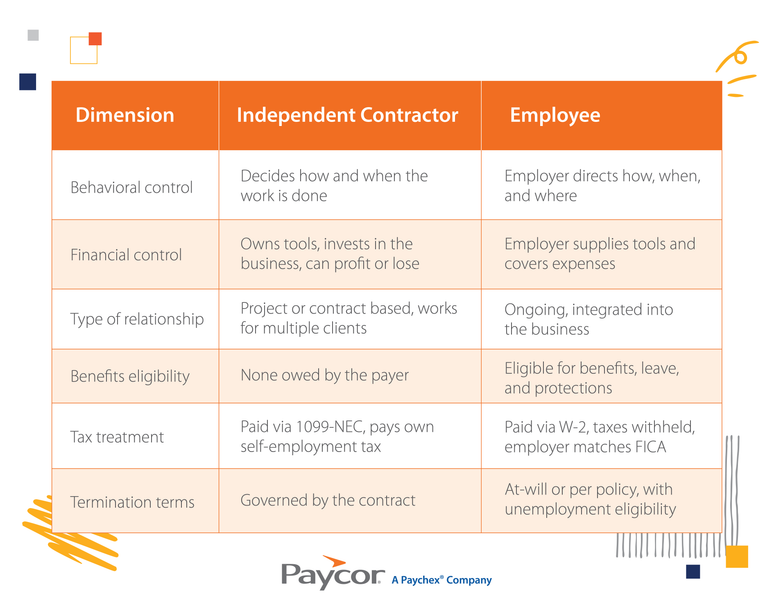
No single row settles the contractor vs. employee question on its own. Agencies weigh the full picture, so a worker who looks independent on tools but is directed on hours and methods may still be an employee. Read the whole chart together, not one line at a time.
The Classification Tests Employers Must Apply
Three frameworks govern most classification decisions, and which one applies depends on the question you’re answering. The IRS Common Law Test controls federal tax treatment. The DOL Economic Reality Test controls FLSA questions like overtime and minimum wage. The ABC Test controls many state wage, unemployment, and workers’ compensation determinations. No single test governs everything, so the safe approach is to satisfy every test that affects your situation, and to default to the strictest one when your workforce crosses state lines.
IRS Common Law Test
The IRS sorts its factors into three categories. Behavioral control asks whether the business directs how the worker does the job, through instructions, training, and oversight. Financial control asks who controls the economic side: investment in equipment, unreimbursed expenses, the chance of profit or loss, and whether the worker offers services to the market. Type of relationship asks how the two sides see the arrangement, looking at written contracts, benefits, permanence, and whether the work is a core part of the business.
When a classification is genuinely unclear, an employer or worker can file IRS Form SS-8 to request an official determination. The IRS reviews the facts and issues a ruling, though the process can take months, so it suits ambiguous cases rather than routine hires.
DOL Economic Reality Test
Under the FLSA, the DOL asks a single underlying question: as a matter of economic reality, is the worker economically dependent on the employer, or in business for themselves? The analysis weighs several factors together, including the worker’s opportunity for profit or loss based on managerial skill, the relative investments of the worker and the employer, the permanence of the relationship, the degree of control, how integral the work is to the business, and the skill and initiative the work requires.
The governing rule here is in flux, and employers should track it. The DOL’s 2024 final rule set out a six-factor, totality-of-circumstances version of this test, but in May 2025 the DOL issued Field Assistance Bulletin 2025-1 announcing it would stop enforcing the 2024 rule and revert to its earlier economic-reality guidance from Fact Sheet #13. In March 2026 the DOL proposed a new rule to replace the 2024 standard. The 2024 rule technically still applies in private litigation, so the practical takeaway is to treat economic dependence as the touchstone, document your reasoning, and keep an eye out for the final rule.
State-Level ABC Test
Many states apply the ABC Test, which is tougher on employers because it presumes a worker is an employee unless the business proves all three of these: (A) the worker is free from the company’s control and direction, (B) the work falls outside the company’s usual course of business, and (C) the worker is customarily engaged in an independently established trade of the same nature. Failing any one prong makes the worker an employee.
California enforces the strictest version, codified after the Dynamex decision in Assembly Bill 5, and part B is where many arrangements fail, since a worker doing the company’s core work cannot be a contractor there no matter how independent they otherwise look. If you employ remote or multi-state workers, classification follows where the worker sits, so a role that is fine in one state can be misclassification in another. Check the rule in every state where your workers perform the work.
Tax Differences for Employers
The tax obligations for all parties diverge sharply. For an employee, the employer withholds federal income tax and the employee’s share of Social Security and Medicare, pays the matching employer share of FICA, pays federal and state unemployment tax (FUTA and SUTA), and files a W-2. For a contractor, the employer withholds nothing and simply issues a 1099-NEC for annual payments at or above the reporting threshold, while the contractor pays their own self-employment tax. Our breakdown of W-2 vs. 1099 covers the paperwork side in detail.
One number changed significantly for 2026. The 1099-NEC reporting threshold rose from $600 to $2,000 for payments made after December 31, 2025, and it will adjust for inflation starting in 2027. Payments in the 2025 tax year still use the old $600 threshold. When misclassification is found, the cost lands on the employer: you can owe the employer’s share of Social Security and Medicare taxes you never paid, plus the income tax and FICA you should have withheld. IRS Section 3509 sets reduced rates for these assessments, but the reduction doesn’t apply if the misclassification was intentional or you failed to file the required 1099s, and interest and penalties can still stack on top.
Benefits and Costs: The Real Business Tradeoff
The sticker price of a contractor usually looks lower than an employee’s, but the full comparison is wider than the hourly rate. Employees carry costs contractors do not: health benefits, the employer share of payroll taxes, workers’ compensation coverage, unemployment insurance, and paid leave. Those costs can add 20–30% or more on top of base wages, which is what makes contractors attractive for short-term or variable work.
But that math can flip over time. A contractor billing a premium rate, sometimes through an agency that adds its own margin, can cost more per hour than an employee doing the same work. Add the onboarding friction of repeatedly ramping new contractors and the institutional knowledge that walks out the door when an engagement ends, and a long-running contractor arrangement can quietly cost more than simply hiring. Match the model to the work: contractors for defined, temporary, or specialized needs, and employees for ongoing core work.
Advantages and Disadvantages of Each Classification
Contractors make sense when speed and flexibility matter most. You can bring in a specialist quickly, access skills you don’t need full time, avoid a long-term commitment, and keep fixed overhead low during uneven demand. The trade-off is less control over how and when the work happens, and less continuity.
Employees make sense when control and continuity matter most. You direct how the work gets done, build culture and shared knowledge over time, protect proprietary processes more tightly, and remove the misclassification exposure that comes with contractor relationships. The trade-off is higher fixed cost and a heavier administrative and compliance load. Neither model is better in the abstract; the right choice follows the nature of the work and how much control you need over it.
How to Correctly Engage an Independent Contractor
Engaging a contractor the right way starts before the work does. Put a written agreement in place that defines the deliverables, sets the contractor’s independence in how the work is performed, and states their right to work for other clients. Collect a completed Form W-9 to capture their taxpayer information for year-end reporting and pay against invoices rather than on a regular payroll cycle. Our guides on how to pay 1099 contractors and managing contractor payroll cover the mechanics.
Just as important is what you avoid. Do not impose the behavioral controls that signal employment: setting fixed hours, requiring the work be done on your equipment or in your office, providing ongoing training, or barring the contractor from taking other clients. A strong agreement addresses control, payment terms, and the contractor’s independence, but the document only holds up if the day-to-day relationship matches it.
What Happens When Employers Get It Wrong
The penalties for misclassification come from several directions at once. The IRS can assess back employment taxes with interest and penalties. The DOL can pursue unpaid overtime and minimum wage under the FLSA. States can levy their own fines and pursue unpaid unemployment and workers’ compensation contributions. And misclassified workers can bring private or class-action claims for the benefits and wages they were denied. The exposure can compound because one misclassified role usually signals a pattern across similar roles.
There is a path to fix the situation before an audit does. The IRS Voluntary Classification Settlement Program (VCSP) lets eligible employers reclassify workers as employees going forward while paying a substantially reduced portion of the employment tax that would have been due, without the interest and penalties a full audit would bring. Coming forward voluntarily almost always costs less than being caught, so if you suspect a classification is wrong, address it rather than wait.
How Paycor Helps You Manage Worker Classification and Payroll
Paycor’s HR and payroll platform helps employers keep the records that classification compliance depends on. It maintains clean documentation, automates tax filings for both W-2 employees and 1099 contractors, and keeps worker data organized so gaps that invite an audit surface early rather than at year-end. Consistent, accurate records are the foundation of defending any classification decision.
For growing businesses running a mixed workforce, Paycor manages employees and contractors in a single payroll system rather than across disconnected tools. That reduces the administrative overhead of paying two worker types and closes the compliance gaps that appear when contractor and employee data live in separate places. Take a tour to see how Paycor helps you pay every worker correctly and keep your classifications clean.This article is general information, not legal or tax advice. Classification rules change and vary by state. Consult qualified employment counsel or a tax advisor before making classification decisions.