








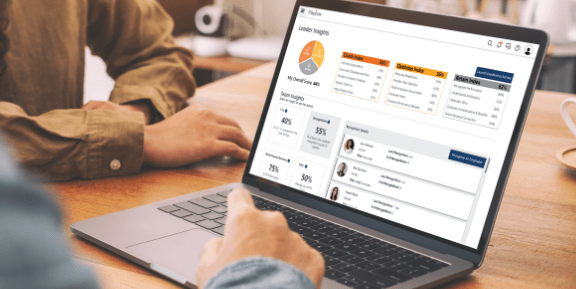

Imagine spending up to 70% less time on tedious HR administrative duties. How much more value could you offer your company with that time? McKinsey & Company data show it’s possible with generative AI, which automates tasks like drafting job posts or summarizing engagement survey responses.
Most HR teams already have access to generative AI, whether via ChatGPT, Claude, or something built into their HCM platform. Learn how HR teams can maximize generative AI to work smarter and harder.
What is Generative AI?
Generative AI refers to artificial intelligence systems that create new content, such as text, images, or code, based on patterns learned from existing data. Unlike a chatbot from ten years ago that could only follow a script, generative AI models like ChatGPT, Claude, and Gemini produce original responses to open-ended prompts.
How Does Generative AI Impact HR?
Gen AI supports HR teams across several areas, including talent acquisition, performance management, and talent development. It takes over the manual, repetitive side of content creation and summarization, ultimately saving time and money. By handling tasks like drafting screening questions and supporting new hires via chatbots, the tools allow HR leaders to focus more on strategy and value-adding efforts.
6 Generative AI Use Cases for HR
Organizations are already putting AI to work in their HR departments. Common use cases include:
1. Recruitment and Hiring
Generative AI tools draft job postings based on the role, level, and team, fine-tuning tone or length in seconds based on your feedback. In addition, they can generate screening questions tailored to a specific role and candidate profile, so a recruiter isn’t reusing the same five questions for every opening regardless of fit.
Tools can create summaries of job seeker responses, strengths, and weaknesses based on screening interview transcripts. After a quick review, HR teams can send the notes right to the hiring manager.
2. Onboarding
HR teams hear the same questions over and over from new hires: How does PTO accrual work? How do I sign up for benefits? What is my log-in information? AI-powered chatbots can be trained as virtual onboarding assistants that provide new employees with real-time answers.
Generative AI also turns lengthy policies and handbooks into role- or department-specific onboarding checklists, training schedules, and resources.
3. Training and Development
AI tools can generate learning plans that include recommended topics, training activities, practice exercises, and resources. Those resources can then be tailored to an employee’s role and career goals.
AI can also create quizzes, study guides, and role-playing scenarios to help employees apply what they’re learning. Managers can use the same tools to generate coaching questions and development goals.
4. Employee Engagement
Generative AI helps HR teams make sense of employee feedback by analyzing survey responses, comments, and other qualitative data. It surfaces recurring themes and summarizes areas of concern.
From there, HR teams can use those insights to identify opportunities to improve the employee experience, such as addressing workload concerns, improving communication, or strengthening manager support. AI can also help generate follow-up survey questions or discussion prompts based on specific areas of concern.
5. Policy and Document Generation
Generative AI can assist with drafting policies, agreements, and other HR documents based on existing guidelines and requirements, shortening the writing and research process.
The same tools help update existing documents when policies or processes change, comparing versions to identify differences. They translate complex HR language into more accessible explanations for employees. HR professionals should review AI-generated documents for accuracy, compliance, and alignment with company policies before using them.
6. Internal Communications
HR professionals can use generative AI to quickly draft internal communications. Whether announcing a new benefit, explaining a policy change, or reminding employees about an upcoming deadline, AI can adjust the message’s tone, length, and level of detail based on the audience.
AI can also repurpose the same information for different channels, such as turning a detailed HR announcement into a short email, intranet post, or manager talking points.
How to Start Using Generative AI in HR
Ready to see how generative AI can save you time? Get started with these tips.
Test It Before You Trust It
Trying to overhaul your entire workflow overnight isn’t realistic. Start with a low-risk task and a specific goal, then build from there. For example, use a generative AI tool to draft an employee survey or turn a lengthy HR resource into a concise summary. These tasks give your team an opportunity to experiment, evaluate the output, and learn where AI can add value before applying it to more complex HR processes.
Prompt Effectively
The quality of a generative AI response depends largely on the information you provide. When creating a prompt, focus on three things:
- Your objective
- The context the tool needs
- The format you want the response to take
For example, instead of asking AI to “write an employee survey,” explain what you want to learn from employees, who will take the survey, how many questions you need, and how you want the questions formatted. The more specific the prompt, the more useful the output.
Establish Governance Frameworks
Without governance in place, AI can cause costly mistakes. SHRM outlines examples of AI in HR when it goes wrong, including when Amazon’s AI prioritized resumes from men and downgraded any resumes that included the word “women.”
Before using generative AI for HR tasks, establish clear guidelines for how employees can use it and what information they can enter. Your AI governance framework should address data privacy, appropriate use cases, human oversight, and how AI-generated content will be reviewed for accuracy and bias.
Be Transparent
Employees become more comfortable experimenting with generative AI when they understand how it is intended to support their work rather than replace it. HR can help set that expectation by communicating why and how the company plans to use AI.
Provide opportunities for employees to practice using approved AI tools and learn how to write effective prompts, evaluate AI-generated content, and protect sensitive information. Giving employees the skills to use AI responsibly can help turn uncertainty into a more productive part of their everyday work.
How Generative AI Will Transform HR
AI is more than a workplace trend, and generative AI is likely to move beyond individual tasks as the technology becomes more capable. Agentic AI, for example, can take on multi-step workflows by interpreting a goal, deciding what actions are needed, and completing tasks with less hands-on direction. In HR, that could mean AI handling a series of connected tasks rather than simply generating a document or answering a question.
This shift could also move AI from task automation toward decision support. Instead of simply helping HR teams work faster, AI can analyze large amounts of workforce data, surface patterns, and provide recommendations that help HR professionals make more informed decisions. As these capabilities expand, HR professionals should continue to provide the context, judgment, and oversight needed to make decisions that affect employees.
How Paycor WISE Helps
Paycor WISE, our intelligent HCM, uses generative and agentic AI to help HR leaders reclaim 40% of their time spent on repetitive work and redirect it toward the outcomes that matter most.
WISE delivers context-aware AI that knows your workforce, understands your
workflows, and acts at the right time. Capabilities include:
- Detects and flags unusual pay spikes, missing hours, policy violations, and historical deviations in real time
- Provides personalized, multi-channel guidance across chat, email, modals, voice, and collaboration tools
- Continuously reprioritizes tasks, risks, and opportunities based on workforce data
- Automatically links records across HRIS, payroll, benefits, time, and LMS
Backed by experienced HR and legal advisors, the tool provides outputs that are accurate, compliant, contextualized, and defensible.
Learn more about Paycor WISE today.